
Author: Abhishek Singh | SEO & CRO Consultant | 6+ Years of Experience
What Is Search Everywhere Optimization?
Search Everywhere Optimization (SEvO) is a search visibility strategy that helps brands get discovered across Google, AI search, social platforms, video platforms, communities, local search, and other places where customers research information.
Traditional SEO focuses heavily on visibility in search engine results. SEvO expands that approach by considering AI search optimization, generative engine optimization (GEO), answer engine optimization (AEO), social search optimization, and brand visibility as connected parts of the same customer journey.
The objective is not to publish content everywhere. It is to identify where your audience searches, create useful information for those environments, and build a consistent brand presence that can be discovered, trusted, and referenced.
Why Search Everywhere Optimization Matters in 2026
Search is no longer limited to a list of blue links.
A customer might search Google for a problem, use an AI assistant to compare solutions, watch a YouTube review, check Instagram for examples, read Reddit discussions, and then search the brand again before making a decision.
Semrush's 2026 research describes audiences engaging with 7+ platforms and spending 4+ hours daily across search surfaces, highlighting how fragmented modern discovery has become.
AI is accelerating this shift. Google now includes AI Overviews and AI Mode in its search experience, while Google's guidance explains how AI search can use multiple related searches to gather information from different sources.
This creates a new visibility problem:
A brand can rank well on Google and still be difficult to find elsewhere.
That is where Search Everywhere Optimization becomes useful.
Search Everywhere Optimization vs. Traditional SEO
|
Traditional SEO |
Search Everywhere Optimization |
|
Primarily focuses on search engines |
Covers multiple discovery surfaces |
|
Optimizes websites and webpages |
Optimizes websites, profiles, videos, communities, and more |
|
Measures rankings, impressions, and clicks |
Measures visibility, mentions, citations, branded demand, and conversions |
|
Keyword-focused |
Intent, entity, context, and platform-focused |
|
Google is often the main search environment |
Google, AI, social, video, communities, and other platforms are considered |
|
Website traffic is a major outcome |
Brand visibility and influence across the journey are also important |
This does not mean traditional SEO is becoming irrelevant.
Google's current guidance is explicit: the foundational SEO practices that help pages perform in Google Search also remain relevant to AI features such as AI Overviews and AI Mode. There are no special technical requirements or separate AI markup required to appear in these features.
SEvO should therefore be viewed as an expansion of SEO rather than a replacement for it.
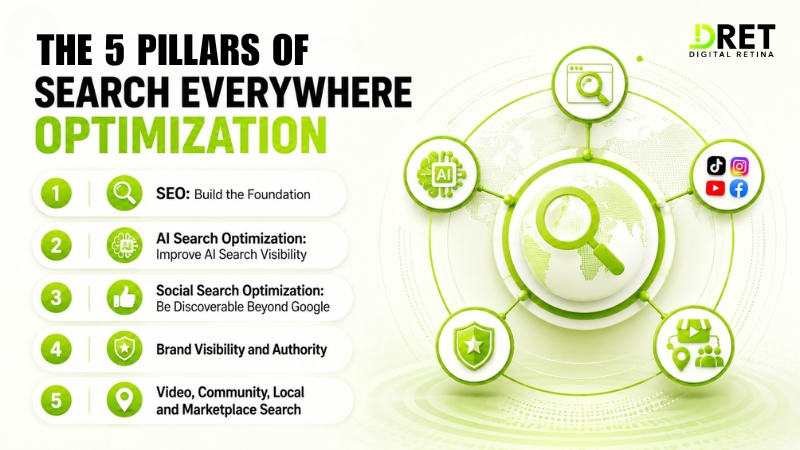
The 5 Pillars of Search Everywhere Optimization
1. SEO: Build the Foundation
Your website should remain the primary source of authoritative information about your business.
Strong technical SEO, crawlability, internal linking, useful page structure, fast experiences, clear navigation, and original content still matter.
Google recommends making important information available in textual form, maintaining good page experience, using structured data accurately where relevant, and keeping business and product information up to date.
Start with:
-
Search-intent-focused pages
-
Strong internal linking
-
Clear website architecture
-
Original research and examples
-
Helpful service and product information
-
Accurate author and business details
-
Relevant images and videos
-
Strong technical foundations
Without this foundation, expanding into AI and social channels can simply distribute a weak message further.
2. AI Search Optimization: Improve AI Search Visibility
AI search optimization focuses on making your expertise easier for AI-powered search systems to understand and reference.
This includes Google AI Overviews, Google AI Mode, ChatGPT, Gemini, Perplexity, and other generative search experiences.
Two terms frequently appear in this area:
Answer Engine Optimization (AEO) focuses on providing direct, well-structured answers to questions.
Generative Engine Optimization (GEO) generally refers to improving the likelihood that a brand or its information is represented in generative AI responses.
Google's guidance on AI features emphasizes that these approaches should build on established SEO fundamentals rather than replace them.
For better AI search visibility, focus on:
-
Answering important questions early
-
Providing original information rather than generic summaries
-
Demonstrating first-hand expertise
-
Supporting factual claims with credible sources
-
Using clear headings and logical content structure
-
Maintaining consistent information about your brand
-
Covering a topic comprehensively without unnecessary repetition
The important point is that there is no reliable shortcut that guarantees an AI mention. Strong information architecture, relevance, authority, and useful content remain more sustainable than trying to manipulate AI responses.
3. Social Search Optimization: Be Discoverable Beyond Google
Social platforms have become important discovery environments, especially for products, creators, local businesses, lifestyle topics, and recommendations.
Social search optimization means making your social content and profiles easier to discover when users search within platforms such as YouTube, Instagram, LinkedIn, TikTok, Pinterest, or relevant communities.
Optimization should reflect the platform.
For example:
-
Use descriptive YouTube titles that match real questions.
-
Include relevant language naturally in social captions.
-
Build LinkedIn posts around specific professional problems.
-
Use clear profile descriptions.
-
Create short videos answering one focused question.
-
Turn frequently asked customer questions into platform-native content.
Do not copy one article across every channel. Take the core insight and adapt it to the way people consume information on each platform.
4. Brand Visibility and Authority
Search visibility is stronger when your brand information is consistent across the web.
Imagine a customer finds your website through Google, then searches your company in ChatGPT, checks LinkedIn, reads reviews, and watches a YouTube video.
If each source presents different descriptions, services, expertise, or company information, trust can weaken.
Your digital footprint should therefore be consistent across:
-
Website
-
Google Business Profile
-
Social profiles
-
Industry directories
-
Review platforms
-
YouTube
-
Digital PR
-
Expert contributions
-
Relevant community discussions
The goal is not to manufacture mentions. It is to build genuine authority that can be supported by multiple credible sources.
5. Video, Community, Local and Marketplace Search
Different audiences use different discovery habits.
A person looking for a tutorial may start on YouTube. Someone choosing a restaurant may use Google Maps. A buyer may search a marketplace. A professional may turn to LinkedIn or an industry community.
A practical search everywhere optimization strategy therefore begins with the audience rather than a predetermined list of platforms.
Ask:
-
Where does my audience first discover solutions?
-
Where do they compare alternatives?
-
Where do they look for reviews or proof?
-
Where do they ask other people for recommendations?
-
Where does the final conversion happen?
Your answers should determine where you invest resources.
How to Build a Search Everywhere Optimization Strategy
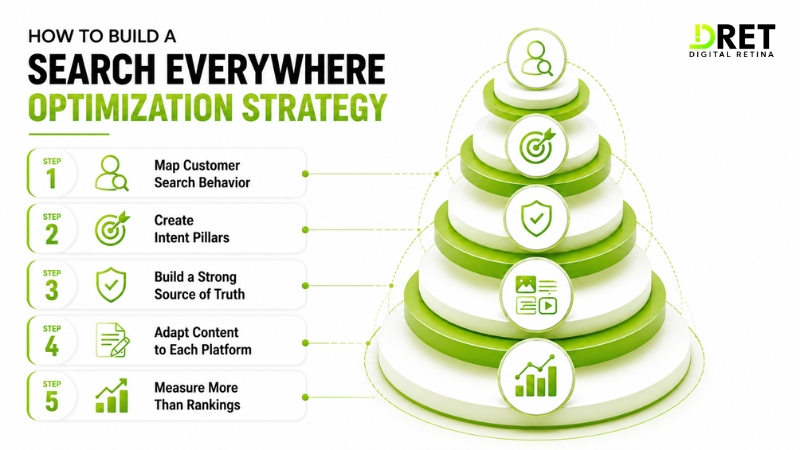
Step 1: Map Customer Search Behavior
Start with customer questions, not just keywords.
Interview recent customers, review support conversations, analyze internal search data, and study questions appearing across Google, social platforms, communities, and AI tools.
Semrush recommends asking recent customers how they discovered and researched a business because the answers can reveal the actual platforms involved in a conversion journey.
Step 2: Create Intent Pillars
Instead of creating one page for every keyword, group related searches around the underlying problem.
For example, a company targeting "AI SEO" might need content addressing:
-
What is AI SEO?
-
How does AI search work?
-
How does AI search differ from traditional search?
-
How can a brand measure AI visibility?
-
What content helps AI systems understand a business?
This creates a connected topic ecosystem rather than isolated keyword pages.
Step 3: Build a Strong Source of Truth
Your website should clearly explain your products, services, expertise, processes, people, and original insights.
Then distribute those ideas across relevant platforms.
This approach creates consistency without requiring your marketing team to invent completely different information for every channel.
Step 4: Adapt Content to Each Platform
A detailed article, YouTube video, LinkedIn post, Instagram carousel, and Reddit response should not all look identical.
Use the same underlying expertise but change the format, depth, examples, and presentation according to user intent.
Step 5: Measure More Than Rankings
Search Everywhere Optimization requires broader measurement.
Track:
-
Organic visibility
-
AI search visibility
-
AI citations
-
Branded search demand
-
Social discovery
-
Video visibility
-
Referral traffic
-
Leads and sales
-
Assisted conversions
AI Overviews are included in Google's Search Console Performance reporting, so marketers can evaluate their impact through the existing search performance data rather than assuming Google has created a separate dedicated AI report.
That distinction matters when measuring AI visibility. Do not describe this as a newly launched dedicated generative AI report unless Google provides separate documentation confirming such a feature.
A Practical Example of SEvO
Consider a B2B software company targeting the topic "CRM automation."
A traditional SEO campaign might create an article targeting CRM automation and build links to it.
A Search Everywhere Optimization strategy would extend that topic across the customer's research journey:
Google: Create an authoritative guide explaining CRM automation.
AI search: Answer specific comparison, implementation, pricing, and use-case questions clearly.
YouTube: Demonstrate how CRM automation works.
LinkedIn: Share expert opinions and real implementation lessons.
Communities: Answer genuine questions about CRM workflows.
Website: Publish case evidence, documentation, comparisons, and product information.
The objective is not simply to appear five times. It is to create multiple credible touchpoints around the same customer problem.
That repeated exposure can strengthen familiarity and branded demand while giving search and AI systems more context about the company.
How to Measure Search Everywhere Optimization
One of the biggest mistakes is treating clicks as the only measure of success.
AI-generated answers can provide information without sending a traditional website visit. Adobe reported that web traffic from AI-driven referrals in the United States increased more than tenfold between July 2024 and February 2025. Adobe also reported that AI referrals were rapidly approaching traditional channels in conversion rates and revenue per visit.
Adobe has also reported much larger growth for specific sectors. For example, its September 2025 analysis found that generative AI traffic to U.S. travel websites increased 3,500% year over year in July 2025, based on an analysis of more than 8 million travel-site visits. This is a travel-specific figure and should not be generalized across all industries.
That makes brand visibility an important measurement layer.
A useful reporting framework includes:
|
Measurement Area |
What to Monitor |
|
Search |
Rankings, impressions, clicks |
|
AI |
Mentions, citations, AI visibility |
|
Brand |
Branded searches and demand |
|
Social |
Search discovery and engagement |
|
Video |
Views, discovery, watch behavior |
|
Community |
Relevant mentions and referrals |
|
Business |
Leads, sales, assisted conversions |
Branded search can be particularly useful because it indicates that people are actively looking for your business rather than simply encountering a generic category result.
Common Search Everywhere Optimization Mistakes
Trying to Be Everywhere
You do not need every platform. Focus on the channels where your audience actually researches and makes decisions.
Treating GEO as a Magic SEO Shortcut
GEO and AEO do not replace good content, authority, technical SEO, or user-focused information.
Publishing the Same Content Everywhere
Repurpose ideas, not identical posts. Each platform has different search behavior and content expectations.
Ignoring Traditional SEO
AI search still depends heavily on web content and search infrastructure. Strong SEO fundamentals remain important to AI search experiences.
Measuring Only Traffic
A brand can influence a decision before a click occurs. Track visibility, branded demand, citations, mentions, conversions, and assisted outcomes alongside traffic.
Frequently Asked Questions
Is Search Everywhere Optimization replacing SEO?
No. SEO remains the foundation. Search Everywhere Optimization extends SEO principles across AI, social, video, community, local, and other discovery environments.
What is the difference between AEO and GEO?
AEO generally focuses on producing clear answers for answer-oriented search experiences, while GEO focuses on improving brand and content visibility within generative AI responses. Both support AI search optimization, while foundational SEO remains important.
How do I optimize for Google AI Overviews?
Use Google's established SEO fundamentals, create helpful and original content, ensure your pages are crawlable and indexable, and provide useful text supported by relevant media where appropriate. Google says there are no additional technical requirements specifically for AI Overviews or AI Mode.
Does Search Everywhere Optimization work for small businesses?
Yes, but the strategy should be focused. A local business may prioritize Google Search, Maps, reviews, Instagram, YouTube, and local communities, while a B2B company may prioritize Google, LinkedIn, YouTube, industry publications, and AI search.
How long does SEvO take to work?
There is no fixed timeline. Technical improvements can produce relatively quick changes, while brand authority, third-party mentions, social visibility, and AI representation generally require consistent effort over time.
Final Thoughts
The search journey has changed, but the fundamentals of useful marketing have not.
People still want accurate answers, credible recommendations, useful demonstrations, and trustworthy businesses. What has changed is where they look for those things.
Search Everywhere Optimization provides a framework for responding to that behavior.
The strongest strategy is not to chase every new AI tool or social platform. It is to understand your audience's research journey, build authoritative source content, adapt that expertise to relevant channels, maintain consistent brand information, and measure visibility beyond traditional rankings.
Strong SEO foundations and valuable, original content remain important as AI becomes a larger part of the search experience.
In 2026, the brands most likely to build durable search visibility will not simply be the ones ranking for the most keywords. They will be the brands that are useful, credible, and recognizable wherever their customers go to find answers.
Author
Abhishek Singh | SEO & CRO Consultant | 6+ Years of Experience
Abhishek Singh is an SEO and CRO Consultant with 6+ years of experience working on organic search visibility, content strategy, conversion optimization, and emerging AI search opportunities. His approach combines technical SEO, search-intent analysis, content strategy, and practical conversion insights to help businesses build measurable search visibility.
Ready to Implement These Strategies?
Our team of digital marketing experts can help you navigate these trends and create a winning strategy.