

Abhishek Singh | SEO & CRO Consultant | 6+ Years of Experience
Google Local Services Ads rankings are influenced by your bid, profile quality, relevance, responsiveness, reviews, location, search context, and the likelihood of generating a lead. Google also considers verification, business information, images, response time, and the overall health and diversity of the Local Services ecosystem. Google's official Local Services Ads ranking documentation
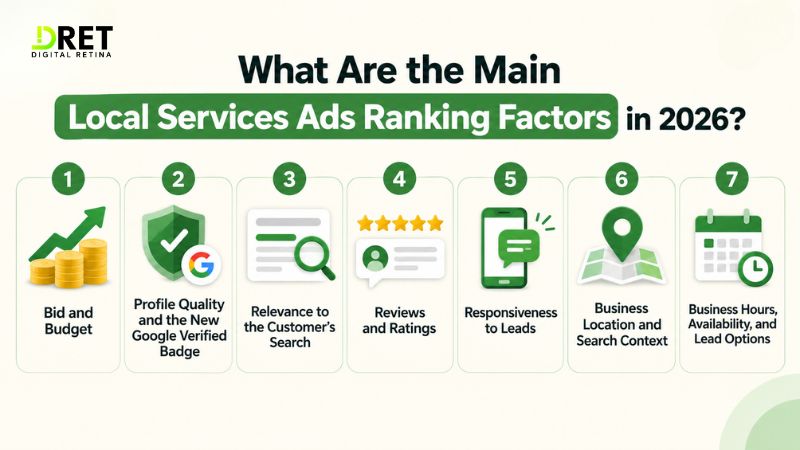
The most important factors to focus on are:
-
Bid and bidding strategy
-
Profile quality
-
Relevance to the customer's search
-
Responsiveness to leads
-
Reviews and ratings
-
Location and search context
-
Business hours, availability, and lead options
Improving these areas can strengthen your profile and increase the likelihood of appearing for relevant local searches.
What Are Google Local Services Ads?
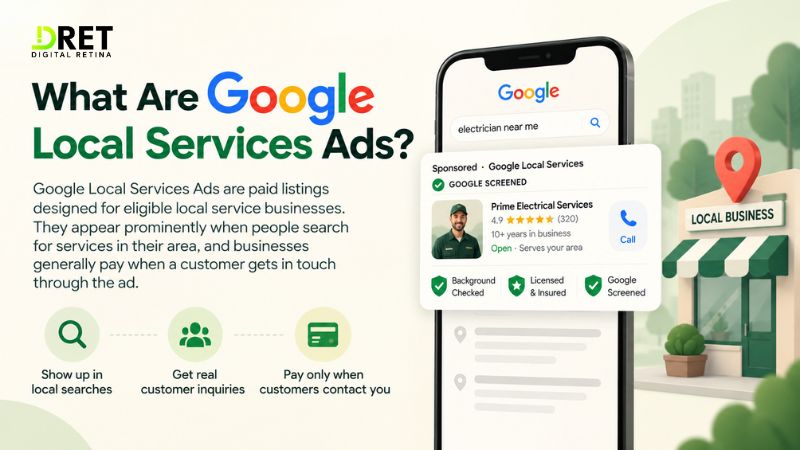
Google Local Services Ads are paid listings designed for eligible local service businesses. They appear prominently when people search for services in their area, and businesses generally pay when a customer gets in touch through the ad.
Unlike traditional search ads, Local Services Ads are strongly connected to business information, service relevance, customer interactions, and profile quality. That makes understanding the ranking factors important for businesses that want more qualified local leads.
What Are the Main Local Services Ads Ranking Factors in 2026?
Google does not publish a simple fixed formula or percentage breakdown for Local Services Ads rankings. Instead, its documentation explains that listings are ranked through an auction that considers the bid along with overall profile quality and the likelihood of generating a lead.
Here are the major factors businesses should focus on.
1. Bid and Budget
Your bid is an important part of the Local Services Ads auction. Google defines the bid as the maximum amount you are willing to pay for a lead, although the actual amount you pay can be lower.
Google recommends the Maximize Leads bid mode for advertisers who want to generate as many leads as possible within their budget. Providers with similar quality and budgets using this strategy can typically receive more leads.
However, a larger budget does not automatically guarantee the top position. Bid works alongside profile quality, relevance, responsiveness, and other factors.
2. Profile Quality and the New Google Verified Badge
A complete, trustworthy profile can improve your ability to compete in Local Services Ads.
Google identifies several profile-quality signals, including:
-
Customer rating
-
Number of reviews
-
Average response time
-
High-quality business images
-
Completed verification checks
-
Business information
-
Relevant service details
Google announced the Google Verified badge on August 20, 2025, with the rollout beginning in October 2025. The badge replaced Google Guaranteed, Google Screened, License Verified by Google, and Money Back Guarantee as part of a unified verification system. Google's August 2025 announcement
The important point is that verification should not be treated as a shortcut to higher rankings. Google announced the badge as a way to communicate completed checks and help customers make decisions. A Homepros report also quoted a Google spokesperson saying the change would have no impact on business ranking, lead delivery, or billing.
In other words, focus on completing the required checks and maintaining a strong profile rather than treating the badge itself as a ranking advantage.
3. Relevance to the Customer's Search
Google considers how relevant your business is to the customer's search.
This includes the services you offer, your business information, and the type of job the customer is looking for. A highly relevant profile can be more competitive when the customer's search clearly matches your services.
For example, if a customer searches for a plumber for a leaking water heater, a plumbing business that clearly lists relevant plumbing services is more closely aligned with that search than a general home-service provider with limited service information.
Keep your service categories and business descriptions accurate. Do not add services simply because you want to appear for more searches.
4. Reviews and Ratings
Reviews are an important part of profile quality and customer trust.
Google considers both the rating and number of reviews when evaluating profile quality. A strong review profile can therefore support your competitiveness in Local Services Ads while also making customers more comfortable contacting your business.
Instead of focusing on reaching an arbitrary review count, build a consistent process for requesting genuine feedback from customers after completed jobs.
Recent reviews can also help demonstrate that your business is actively serving customers, although Google does not publish a specific formula showing how review recency affects ranking.
5. Responsiveness to Leads
How quickly and consistently you respond to potential customers can affect your ability to generate leads.
Google considers responsiveness when determining the likelihood that a business will generate a lead. Slow responses can create a poor customer experience, particularly when customers are contacting several businesses at the same time.
For example, an HVAC company that responds promptly to a customer asking about an air-conditioning repair may have a better opportunity to convert that lead than a business that takes hours to respond.
Monitor missed calls, unanswered messages, and response times regularly. If your team cannot respond quickly during certain periods, review your availability and lead settings.
6. Business Location and Search Context
Location is another important part of Local Services Ads performance.
Google considers the customer's search context, including factors such as the service being requested, location, and other circumstances surrounding the search. This means your business may perform differently for searches made in different areas.
A locksmith serving one part of a city may not receive the same visibility for a search made much farther away. Competition and the number of businesses serving a particular location can also affect results.
Make sure your service areas and business information accurately represent where you actually operate.
7. Business Hours, Availability, and Lead Options
Your operating hours and availability can influence your ability to receive leads.
Google notes that enabling message and/or booking leads can increase the likelihood of receiving leads, particularly during periods when customers may prefer those options.
For example, a locksmith that accepts customers outside standard business hours may be better positioned to capture relevant searches when other providers are unavailable. This does not mean extended hours automatically guarantee higher rankings, but availability can affect whether your business is suitable for a particular customer interaction.
Keep your hours accurate and use available lead options when your business can properly manage them.
How Can You Improve Local Services Ads Visibility?
Improving visibility is less about finding one ranking trick and more about strengthening the signals Google uses to evaluate your profile and likelihood of generating leads.
Step 1: Audit Your Profile
Review your business name, services, service areas, hours, images, verification status, and other profile information. Remove outdated or inaccurate details.
Step 2: Improve Lead Response
Track missed calls, unanswered messages, and response times. Create a process for responding to new enquiries quickly, including outside normal office hours when your business offers that availability.
Step 3: Build Genuine Reviews
Ask satisfied customers for honest reviews after completed jobs. Make review generation part of your normal customer follow-up process rather than trying to obtain a large number of reviews in a short period.
Step 4: Refine Your Services
Make sure the services listed in your profile accurately reflect what your business provides. Clear service information helps Google match your business with relevant customer searches.
Step 5: Review Budget and Bidding
Monitor lead volume, lead quality, and spending before changing your bid. Increasing the budget can create more opportunities, but it should be balanced against the quality and value of the leads you receive.
Step 6: Monitor Performance
Local Services Ads performance can change as customer demand, competition, availability, and profile quality change. Review your results regularly instead of assuming that one optimization will permanently improve visibility.
What Happens If You Have Multiple Business Locations?
If a business has multiple locations serving the same geographic area, Google may show only the highest-ranking ad for a particular user query.
This means creating several profiles or locations does not automatically guarantee greater visibility. Each location should have accurate business information and genuinely represent the area it serves.
Businesses with multiple locations should also monitor how coverage, service areas, and competition differ between locations.
Why Can Local Services Ads Rankings Change Without an Obvious Cause?
Local Services Ads rankings can change because the system considers multiple factors and customer search context.
Changes in competition, bids, customer demand, responsiveness, profile quality, service relevance, availability, or search location can affect which businesses are shown.
Google also states that it continually runs experiments and optimizes the Local Services ecosystem for factors such as overall health, diversity, and opportunity for providers.
As a result, a ranking change does not necessarily mean that your profile has developed a technical problem.
What About Customer Complaints?
Customer complaints should be taken seriously, but businesses should be careful about describing complaint volume as a confirmed Local Services Ads ranking factor.
Google's published ranking documentation does not provide a specific complaint-count formula or state that a certain number of complaints directly lowers an LSA ranking.
The practical takeaway is to monitor complaints as part of overall business quality and customer experience. Resolve legitimate issues, maintain accurate business information, and pay attention to patterns that could affect customer satisfaction and reviews.
Local Services Ads vs. Traditional Google Ads
Local Services Ads and traditional Google Ads serve different advertising purposes. Local Services Ads generally use a pay-per-lead model, while traditional Google Ads commonly use a pay-per-click model with broader campaign and targeting options.
For a detailed comparison of costs, lead generation, and ROI, see Local Service Ads vs Google Ads: Which Delivers Better ROI for Your Business, since pricing and ROI depend on your market and lead volume.
Common Local Services Ads Mistakes to Avoid
Avoid these common mistakes when managing your Local Services Ads profile:
-
Using inaccurate business information: Keep your services, hours, location, and other details current.
-
Ignoring missed leads: Unanswered calls and messages can reduce your ability to convert potential customers.
-
Chasing reviews artificially: Focus on genuine customer feedback rather than shortcuts.
-
Assuming budget solves everything: A larger budget does not replace profile quality or relevance.
-
Listing irrelevant services: Only include services your business genuinely provides.
-
Ignoring availability: Make sure your hours and lead options accurately reflect when customers can reach you.
-
Treating verification as a ranking shortcut: Google Verified confirms completed checks but should not be treated as a guaranteed ranking advantage.
Frequently Asked Questions
Does a bigger budget guarantee the top Local Services Ads position?
No. Budget and bidding are important, but Google also considers factors such as profile quality, relevance, responsiveness, customer search context, and the likelihood of generating a lead. A larger budget alone does not guarantee the top position.
How many reviews do I need to rank higher in Local Services Ads?
Google does not publish a specific minimum number of reviews required for higher Local Services Ads rankings. The number and quality of reviews contribute to profile quality, but there is no public threshold that guarantees better placement.
Does the Google Verified badge improve LSA ranking?
The Google Verified badge should not be treated as a direct ranking boost. Google introduced it to consolidate its verification programs and communicate completed checks to customers. A Homepros report quoting a Google spokesperson stated that the change would have no impact on business ranking, lead delivery, or billing.
Why did my Local Services Ads ranking drop?
A ranking drop can happen because of changes in competition, bids, customer demand, responsiveness, profile quality, relevance, availability, or search context. Google also continually experiments with and adjusts the Local Services ecosystem. Review your profile and recent performance before assuming that one specific factor caused the change. Google's Local Services Ads documentation
Should I use Local Services Ads if I already rank organically?
Yes, potentially. Organic rankings and Local Services Ads visibility are separate opportunities to reach local customers. If your business is eligible, LSA can provide another way to generate enquiries from people actively searching for your services.
Final Takeaway
The most effective way to improve Local Services Ads visibility is to strengthen the factors Google uses to evaluate your business and its likelihood of generating a lead.
Focus on profile quality, relevant services, genuine reviews, fast responses, accurate business information, appropriate bidding, location, and availability. Do not rely on a single ranking shortcut or assume that a higher budget guarantees better placement.
Local Services Ads performance can change as competition, customer demand, and search context change. Regularly reviewing your profile and lead performance gives you a better foundation for sustainable visibility in 2026.
About the Author
Abhishek Singh is an SEO & CRO Consultant with 6+ years of experience helping businesses improve organic visibility, conversion performance, and search-driven growth. His work focuses on practical SEO strategies, search behavior, and measurable digital marketing outcomes.
Ready to Implement These Strategies?
Our team of digital marketing experts can help you navigate these trends and create a winning strategy.