
Author: Abhishek Singh | SEO & CRO Consultant | 6+ Years of Experience
ChatGPT Ads Manager is OpenAI's self-service platform for creating, launching, and managing ads in ChatGPT. Advertisers can set campaign objectives, budgets, locations, ad groups, context hints, creative assets, and landing pages, then monitor impressions, clicks, spend, and conversions. ChatGPT Ads went live for Indian users in late August, while India-specific reporting puts the self-serve Ads Manager opening at September 4, 2026, with a minimum daily budget of ₹725. OpenAI's ChatGPT Ads announcement
Key Takeaways for ChatGpt Ads
-
India availability: ChatGPT Ads became available to Indian Free and Go users in late August 2026, with self-service access reported as opening on September 4.
-
Minimum India budget: Ads Manager currently lists ₹725 per day as the minimum daily campaign budget. OpenAI Ads Manager campaign guide
-
Campaign objectives: Advertisers can choose Views, Clicks, or eligible Conversions objectives.
-
Ad targeting: Context hints help describe the conversations and situations where an ad is relevant.
-
Creative limits: Current guidance allows titles up to 50 characters and ad copy up to 100 characters.
-
Performance: Early third-party data shows lower CTR than traditional search, but Criteo has reported stronger conversion rates from AI-referred traffic in some retail datasets. These are early benchmarks, not universal performance guarantees. The Growth Syndicate's ChatGPT Ads guide Criteo's May 2026 update
-
Important limitation: ChatGPT Ads is a new advertising channel, so pricing, availability, formats, and performance benchmarks can change quickly.
What Are ChatGPT Ads?
ChatGPT Ads are sponsored advertisements that appear separately from ChatGPT's generated answers and can reach users while they explore options, compare products, or make decisions. Advertisers manage these campaigns through OpenAI Ads Manager, where they can configure campaign objectives, budgets, targeting, creative, and measurement. OpenAI Ads Help Center
OpenAI began testing ads in the U.S. on February 9, 2026. The platform subsequently moved toward self-service advertising, with OpenAI announcing the self-service expansion to additional markets later in the year. OpenAI's initial ChatGPT Ads announcement
For businesses, this creates a new form of ChatGPT advertising where brands can appear during conversational research rather than only after a traditional search query.
How Do ChatGPT Ads Work?
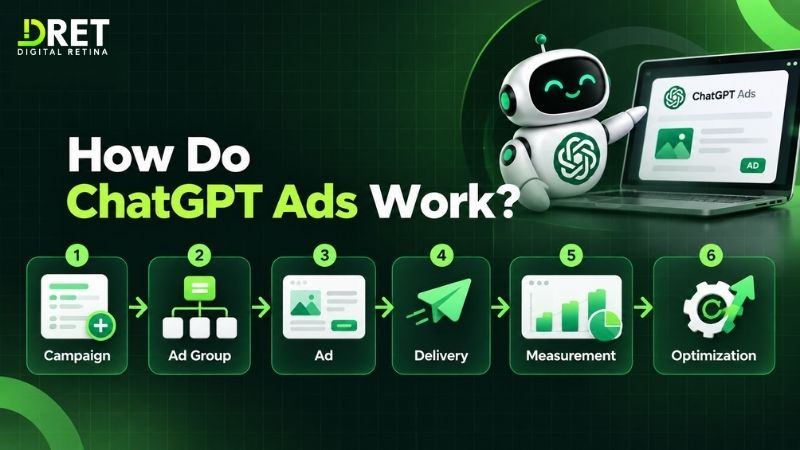
The basic ChatGPT advertising platform workflow is:
Campaign → Ad Group → Ad → Delivery → Measurement → Optimization
At the campaign level, advertisers define the business objective, budget, dates, countries, and other available targeting settings. Campaign objectives currently include Views, Clicks, and Conversions. OpenAI's campaign setup documentation
Ad groups organize ads around different themes, products, use cases, or value propositions. Advertisers can also add context hints that describe the types of conversations in which their products or services may be relevant.
The individual ad contains the creative elements users see, including the advertiser name, logo, title, copy, landing page, and supported creative assets.
The key difference from traditional keyword advertising is that ChatGPT considers conversational context and other eligible relevance signals rather than relying only on a typed search query.
When Did ChatGPT Advertising Launch?
ChatGPT Ads have moved through several stages in 2026:
-
February 9, 2026: OpenAI began testing ads in the U.S. OpenAI's initial testing announcement
-
May 5, 2026: OpenAI announced self-service ads and CPC bidding as the advertising program expanded. Criteo's May 2026 update
-
August 2026: Ads expanded into additional international markets.
-
Late August 2026: ChatGPT Ads went live for eligible Indian users.
-
September 4, 2026: India-focused industry reporting documented the opening of self-service Ads Manager to Indian advertisers, with the ₹725 minimum daily budget. upGrowth's India ChatGPT Ads guide
OpenAI's own August 31 announcement said advertisers could begin purchasing ChatGPT Ads directly through Ads Manager across India, Europe, the Middle East, and North Africa “starting later today.” Because the public reporting around the India rollout uses different dates for the consumer launch and self-service opening, advertisers should rely on their Ads Manager account and OpenAI's current availability documentation for access status.
Where Do Ads Appear in ChatGPT?
Ads appear below ChatGPT responses and are clearly separated from the AI-generated answer.
An ad unit can include:
-
Advertiser name: Identifies the business behind the ad.
-
Logo: Provides brand recognition.
-
Title: Communicates the primary value proposition.
-
Copy: Adds supporting information.
-
Landing page: Takes users to the advertiser's destination.
-
Image or other supported creative: Provides visual information where available.
OpenAI states that advertising does not influence the answers ChatGPT provides.
What Are the ChatGPT Ad Specifications?
Current Ads Manager guidance provides practical limits for advertisers creating ad creative.
|
Ad element |
Current specification |
|
Ad title |
50 characters maximum |
|
Recommended title length |
16–24 characters |
|
Ad copy |
100 characters maximum |
|
Recommended copy length |
32–48 characters |
|
Image |
Supported square creative where applicable |
|
Landing page |
Must be valid and accessible |
The 50-character title and 100-character copy limits are more reliable specifications to use than older guides that describe a 16-character title as the maximum.
I have not included a fixed pixel requirement for the image because current third-party sources disagree on the exact image-size specification. This is one area where advertisers should verify the live Ads Manager upload requirements before preparing a production creative set.
How to Create ChatGPT Ads: Step-by-Step Guide
If you want to learn how to create and run ChatGPT ads, the process starts with an eligible Ads Manager account.
Step 1: Set Up Your Ads Manager Account
Sign in to Ads Manager and complete the required account, business, billing, and verification setup.
Self-service access depends on the country where the legal entity being billed is based. India is currently included in OpenAI's expanding self-service advertising markets. OpenAI Ads Manager availability documentation
Step 2: Create a Campaign
Create a new campaign and choose the business objective that matches what you want to achieve.
Current objectives include:
-
Views: Designed to maximize impressions and visibility.
-
Clicks: Designed to drive valid clicks to your website or product.
-
Conversions: Designed to optimize toward supported conversion events.
You can also define the budget, campaign dates, countries, and available targeting settings.
Step 3: Set Your Budget
For India, OpenAI currently lists a minimum daily campaign budget of ₹725. This is a platform minimum, not a guaranteed CPC, CPM, or cost per conversion. OpenAI's campaign setup documentation
Step 4: Create an Ad Group
Create an ad group around a specific theme, product category, customer need, or value proposition.
For example, a SaaS company could create separate ad groups for:
-
CRM software
-
Marketing automation
-
Sales automation
-
Small-business CRM
This structure makes it easier to test different messages and understand which themes generate useful results.
Step 5: Add Context Hints
Context hints are an important part of how ChatGPT ads work.
Instead of relying only on traditional keywords, describe the conversations or situations where your product is relevant.
For example:
Businesses looking for tools to manage remote teams, track projects, assign tasks, and improve team collaboration.
The goal is to give the advertising system useful information about where your offering may fit.
Step 6: Create Your Ad
Add the required creative information, including:
-
Brand name
-
Logo
-
Headline
-
Description
-
Supported creative assets
-
Landing page
Keep the message closely connected to the customer's likely intent.
Step 7: Set Bidding and Delivery Options
Depending on the campaign objective, Ads Manager supports CPM and CPC buying, while conversion-focused campaigns can optimize toward supported conversion events.
For example:
-
Views: CPM
-
Clicks: CPC
-
Conversions: Conversion-optimized buying options where eligible
The exact options available depend on campaign eligibility and configuration. OpenAI's campaign setup documentation
Step 8: Review and Launch
Before launching, check:
-
Campaign objective
-
Budget
-
Dates
-
Countries and locations
-
Ad group settings
-
Context hints
-
Creative
-
Landing page
-
Billing
-
Conversion tracking
Once verification, billing, campaign settings, and ad review are complete, the campaign can begin serving.
What Industries and Content Are Restricted?
ChatGPT Ads have additional restrictions around sensitive and regulated topics.
Ads are not eligible to appear alongside personal health, mental health, or political conversations, and OpenAI does not allow political advertising in ChatGPT. Other regulated categories may have additional eligibility requirements depending on the market and campaign.
Advertisers should also be careful with categories such as dating, financial services, alcohol, tobacco, gambling, and legal services. Some third-party guides describe these categories as restricted or limited, but not every restriction is publicly documented by OpenAI in the same way. Treat the current Ads Policies and campaign-review result as the source of truth rather than assuming that every category is universally prohibited.
OpenAI also states that ads are not shown to users under 18. OpenAI's ChatGPT Ads announcement
How Much Do ChatGPT Ads Cost?
There is no single fixed ChatGPT ads cost for every advertiser.
The current India minimum is ₹725 per day, but that figure is only the minimum campaign budget. It does not mean that advertisers pay ₹725 for a fixed number of clicks or impressions. OpenAI's campaign setup documentation
Third-party reporting provides useful historical benchmarks, but these should not be treated as official India rate cards. The Growth Syndicate's ChatGPT Ads guide reports that early U.S. CPMs were around $60 at launch, later falling to approximately $25–$45, while early CPC guidance was around $3–$5.
There is still limited reliable India-specific auction data, so converting those international benchmarks directly into an expected Indian CPC would be misleading.
The most useful metrics to evaluate cost and efficiency are:
-
CPC
-
CPM
-
CTR
-
Conversion rate
-
Cost per conversion
-
Total spend
-
Revenue generated
What Does Early ChatGPT Ads Performance Look Like?
Early performance data is still limited, and the available benchmarks should be treated as directional rather than guaranteed results.
The Growth Syndicate's ChatGPT Ads analysis cites Similarweb data showing an overall ChatGPT Ads CTR of 0.68%, with higher-performing advertisers reaching approximately 1% or more. It also notes that direct comparisons with search CTR are imperfect because ChatGPT ads appear after the user has already received an answer.
On conversion quality, Criteo's May 2026 press release reported that AI-referred users converted at approximately 1.5 times the rate of other referral channels in a sample involving 500 U.S. retailers. Criteo also reported that conversion rates in some retail categories were approaching two times traditional search. These figures describe specific datasets and should not be treated as a universal ChatGPT Ads benchmark.
How to Measure ChatGPT Advertising Performance
Ads Manager provides reporting for campaign performance, including impressions, clicks, spend, and available conversion data.
For businesses focused on leads or sales, conversion measurement is particularly important.
A useful measurement framework is:
Impressions → Clicks → Website actions → Conversions → Revenue
This helps you determine whether ChatGPT marketing is generating meaningful business outcomes rather than simply increasing visibility.
Where Is ChatGPT Ads Manager Available?
OpenAI's advertising availability is expanding across multiple regions. Current self-service markets include the United States and a growing group of markets across North America, Europe, Asia-Pacific, Latin America, the Middle East, and Africa, with India included in the international expansion.
Because the list can change as OpenAI expands access, advertisers should check the current OpenAI Ads Manager availability documentation before planning a campaign for a specific country. OpenAI Ads Manager availability documentation
This is preferable to treating a static country list from a third-party article as permanent, particularly for a beta advertising product.
ChatGPT Ads for Businesses: Who Should Consider Them?
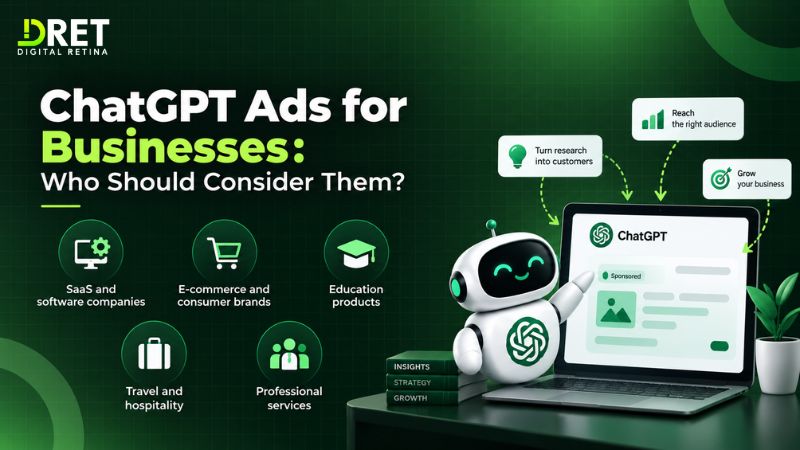
ChatGPT ads for businesses can be relevant when customers commonly research, compare, or evaluate solutions before taking action.
Potential use cases include:
-
SaaS and software companies
-
E-commerce and consumer brands
-
Education products
-
Travel and hospitality
-
Professional services
-
Home and lifestyle products
-
B2B technology
-
Agencies and digital services
The fit depends on whether potential customers use conversational research to understand their options.
For ChatGPT ads for brands, the opportunity is not simply another source of website traffic. It is a way to reach users while they are actively exploring a product category, comparing alternatives, or considering a solution.
ChatGPT Ads vs Traditional Search Advertising
|
Factor |
ChatGPT Ads |
Traditional Search Ads |
|
Environment |
Conversational AI |
Search results |
|
Main signal |
Conversation context and intent |
Search query and targeting |
|
Ad placement |
Within the ChatGPT experience |
Search results pages |
|
Campaign structure |
Campaigns, ad groups, ads |
Campaigns, ad groups/ad sets |
|
Pricing |
CPM, CPC, or eligible conversion billing |
Varies by platform |
|
User journey |
Research, comparison, decision-making |
Query → results → click |
|
Measurement |
Impressions, clicks, spend, conversions where configured |
Clicks, conversions, revenue and other metrics |
ChatGPT Ads also compete for attention with the broader AI-search advertising ecosystem. Google AI experiences, Microsoft Copilot, and other AI platforms are experimenting with different approaches to monetization, while Anthropic's Claude remains an example of an AI product that has taken an ad-free approach.
These differences make privacy, trust, placement, and answer independence important considerations when evaluating AI advertising channels.
What Are the Main Risks or Open Questions?
ChatGPT Ads is still a relatively new channel, so advertisers should not assume that early benchmarks will remain stable.
Three issues deserve particular attention:
Measurement: Attribution can be more complicated when a user discovers a product through a conversational interaction before visiting a website.
CTR: Early data suggests that ChatGPT Ads can have lower click-through rates than traditional search. This may reflect the fact that users receive an answer before seeing an ad rather than clicking an ad to obtain the answer.
Trust and separation: Advertising inside an AI product creates ongoing questions about how users distinguish sponsored recommendations from organic answers. OpenAI's stated position is that ads remain separate from ChatGPT's answers and do not influence them. OpenAI's ChatGPT Ads announcement
These factors make controlled testing and conversion measurement more useful than judging the channel from impressions alone.
Best Practices for ChatGPT Ads
To get more useful results from the ChatGPT ads platform, focus on relevance rather than trying to replicate a traditional search campaign.
1. Match ads to conversation intent: Build ad groups around specific customer needs and situations.
2. Use clear context hints: Explain when your product or service is genuinely useful.
3. Keep the landing page aligned: The destination should directly support the promise made in the ad.
4. Test multiple messages: Create variations around different benefits, use cases, and customer problems.
5. Track conversions: Click volume alone does not show whether advertising is contributing to business growth.
6. Start with controlled budgets: Use early campaigns to learn which topics, messages, and audiences generate useful results before scaling.
7. Separate campaign objectives: Keep meaningfully different business goals, regions, or product categories in separate campaigns where appropriate.
FAQs About ChatGPT Ads
Can businesses advertise on ChatGPT?
Yes. Eligible businesses can use OpenAI Ads Manager to create and manage ChatGPT advertising campaigns. Availability depends on the advertiser's country and account eligibility.
Are ChatGPT Ads available in India?
Yes. ChatGPT Ads became available to eligible Indian users in late August 2026, and India-focused reporting documented self-service Ads Manager access from September 4, with a ₹725 minimum daily budget.
How much does it cost to advertise on ChatGPT?
There is no universal fixed price. The current minimum daily campaign budget for INR is ₹725. CPC and CPM depend on the selected campaign objective, bidding, auction conditions, and delivery.
Do ChatGPT Ads change ChatGPT's answers?
No. OpenAI states that ads are separate from ChatGPT's answers and that advertising does not influence the answers ChatGPT provides.
How are ChatGPT Ads targeted?
ChatGPT Ads use contextual and intent signals. Advertisers can also provide context hints describing conversations or situations where their products may be relevant.
What should businesses track?
Track impressions, clicks, CTR, spend, CPC or CPM, conversions, and ultimately business outcomes such as qualified leads, purchases, and revenue.
Final Takeaway
ChatGPT Ads Manager gives businesses a self-service way to create, launch, manage, and measure advertising campaigns within ChatGPT. Advertisers can choose campaign objectives, set budgets, create ad groups, add context hints, upload creative, define landing pages, and monitor performance.
For businesses exploring generative AI advertising, the key is to treat ChatGPT as a distinct advertising environment rather than simply another search network. Early data suggests the channel has different click behavior from traditional search, while AI-referred traffic has shown promising conversion signals in some third-party datasets. Those results are still early and should be validated against your own campaign data.
Because the ChatGPT advertising platform is still developing, advertisers should check OpenAI's latest Ads Manager documentation for changes to targeting, pricing, creative specifications, measurement, and market availability.
Ready to Implement These Strategies?
Our team of digital marketing experts can help you navigate these trends and create a winning strategy.