
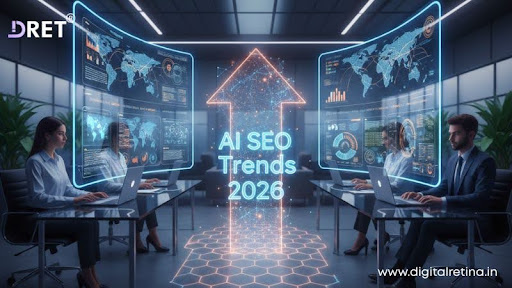
In 2026, AI is playing a central role in the evolution of SEO, changing how search engines analyze content, understand user intent, and rank results. Technologies like AI content optimization, semantic and entity-based search, predictive analytics, and intelligent automation are helping digital marketers create more accurate, user-focused strategies. As AI-powered search experiences and zero-click results continue to grow, staying updated with these AI SEO trends is critical for improving visibility, building authority, and maintaining long-term search performance in a competitive digital landscape.
How AI Is Redefining SEO Visibility?
In AI-led search environments, users often receive instant, AI-generated answers, reducing the need to click on traditional organic links. Search engines now prioritize delivering solutions directly within the search interface, changing how users interact with results.
What this means for marketers:
- Organic traffic may decline even when keyword rankings improve.
- Brand exposure within AI-generated answers, summaries, and citations becomes critical.
- SEO success shifts from “ranking #1” to being referenced, quoted, or recommended by AI.
- Visibility across AI touchpoints builds brand recall and long-term trust.
In 2026, visibility equals influence—even when users never click through to your website.

Entity-Based SEO Is Now the Backbone of Search
Modern AI-powered search systems no longer rely only on keywords—they understand the web through entities such as brands, businesses, people, locations, and services. Instead of matching exact phrases, AI connects concepts and evaluates how entities relate to one another across the digital ecosystem.
Why entity SEO matters:
- AI connects data points from multiple trusted sources to validate your brand.
- Well-defined entities are more likely to be cited, summarized, and recommended in AI-generated answers.
- Strong entity signals help build long-term trust and authority, not just short-term rankings.
- Recognized entities reduce ambiguity, making it easier for AI to choose your brand confidently.
Entity optimization helps AI understand who you are, what you offer, and why your brand deserves visibility—making it a foundational SEO strategy in 2026.
AI Content Evaluation Is More Advanced Than Ever
In 2026, AI evaluates content quality far beyond basic grammar checks or keyword usage. Modern search systems assess meaning, usefulness, credibility, and real-world value to determine which content deserves visibility.
AI looks for:
- Demonstrated expertise, experience, and topical authority.
- Original viewpoints supported by practical insights or data.
- Depth, completeness, and how well content satisfies user intent.
- Clear structure that makes information easy to scan and understand.
Content that performs best:
- In-depth industry analysis with data-backed conclusions.
- Case studies, examples, and firsthand experiences.
- Well-structured long-form guides that answer questions comprehensively.
- Content written for humans first, not algorithms.
Content that struggles:
- Over-optimized, keyword-heavy pages designed only to rank.
- Generic AI-written blogs that lack originality or insight.
- Thin, repetitive, or duplicated content offering little real value.
- Content that fails to clearly demonstrate expertise.
In today’s AI-driven search landscape, quality is measurable—and content that genuinely helps users consistently wins.

Agentic SEO Is Changing How Decisions Are Made?
Agentic AI systems don’t just retrieve information—they analyze, compare, and take action on behalf of users. Instead of presenting a list of links, these systems help users make decisions by evaluating options, credibility, and outcomes.
- Content must guide users through every stage of the decision journey, from awareness to action.
- Pages should clearly answer “what this is,” “why it matters,” and “what to do next”.
- Strong trust signals such as reviews, testimonials, certifications, and case studies are essential.
- Clear CTAs help AI determine when your brand is the right recommendation.
Optimizing for agentic SEO means positioning your brand as the safest, most reliable, and most intelligent choice—not just the most visible one.
Conversational and Voice Search Continue to Rise
Voice and conversational search are becoming a core part of how users interact with AI-powered platforms. Instead of typing short keywords, users now ask complete, natural-language questions, expecting fast and accurate responses. Voice queries closely reflect real human speech patterns and intent, making them more specific and action-focused.
- Write content in a natural, conversational tone that mirrors how people speak.
- Include direct, concise answers that AI can easily extract and read aloud.
- Add FAQ sections to address common questions clearly and efficiently.
- Optimize for local SEO signals, including location-based phrases.
Voice-friendly content improves discoverability across smart assistants, mobile voice search, and AI chat interfaces, helping brands stay visible in hands-free and on-the-go search moments.
Structured Data Is a Core AI SEO Signal
AI-powered search systems rely heavily on structured data to accurately interpret, classify, and connect content. While high-quality content is essential, structured data helps AI clearly understand what your content represents and how it should be used.
- Improved AI comprehension and faster content interpretation.
- Higher chances of being featured in AI-generated answers and summaries.
- Stronger entity associations across search ecosystems.
- Better alignment with voice assistants and agentic AI systems.
Without structured data, even high-quality content may remain misunderstood or overlooked by AI, limiting its visibility in modern search experiences.
Topical Authority Outperforms Single-Page Optimization
In 2026, AI-powered search systems prioritize brands that demonstrate deep, comprehensive coverage of a topic, not just isolated high-ranking pages. Instead of evaluating content individually, AI assesses how well your entire website supports a subject area.
How to build topical authority:
- Create pillar pages that cover core topics in depth and support them with related cluster content.
- Interlink related articles strategically to strengthen contextual relevance.
- Update existing content regularly with fresh insights, data, and examples.
- Address multiple stages of user intent, from awareness to decision-making.
Topical authority signals tell AI that your brand is a trusted subject-matter expert, not a one-time publisher—making your content more likely to be cited, summarized, and recommended across AI-driven search results.
Human Strategy + AI Execution Is the Winning Formula
AI excels at automation, data analysis, and pattern recognition, making SEO processes faster and more efficient. However, strategy, creativity, and judgment remain uniquely human strengths that AI cannot replace.
- Strategic thinking and long-term planning.
- Creativity, storytelling, and emotional connection.
- Brand voice, values, and ethical decision-making.
- Understanding nuanced user intent and business goals.
The most successful digital marketers treat AI as a co-pilot, not a replacement—using technology to amplify human intelligence, not replace it.
Final Thoughts
AI SEO in 2026 requires a fundamental mindset shift—from chasing rankings to building lasting authority, trust, and visibility across AI-driven search ecosystems. To stay ahead, brands must embrace entity and topical SEO, invest in high-quality experience-based content, optimize for AI understanding and trust, and measure success beyond clicks and rankings. At DRET, we help brands design future-ready AI SEO strategies aligned with how modern search truly works—so if your goal is to be seen, cited, and recommended by AI, now is the time to evolve.
Ready to Implement These Strategies?
Our team of digital marketing experts can help you navigate these trends and create a winning strategy.