
Author: Abhishek Singh | SEO & CRO Consultant | 6+ Years of Experience
AI search ranking factors are the signals and content characteristics that can influence whether a page is discovered, understood, selected, and cited in AI-generated search results. The most important areas are search relevance, answer quality, topical depth, first-hand experience, E-E-A-T, external authority, entity clarity, technical accessibility, freshness, and passage-level relevance.
AI visibility is also becoming easier to measure. On June 3, 2026, Google launched dedicated generative AI performance reports in Search Console for AI Overviews and AI Mode. The reports currently provide visibility data such as impressions, pages, countries, devices, and dates, while the feature is being rolled out to a subset of sites.
However, Google has not published a separate list of official AI search ranking factors or an "AI visibility score." Google says its AI features build on existing Search systems and that there are no additional technical requirements or special schema required specifically for AI Overviews or AI Mode.
So the practical question is not:
"What secret ranking signal does AI use?"
It is:
"What makes a source useful, trustworthy, relevant, and clear enough to be selected when an AI system needs to answer a question?"
What Are the Main AI Search Ranking Factors?
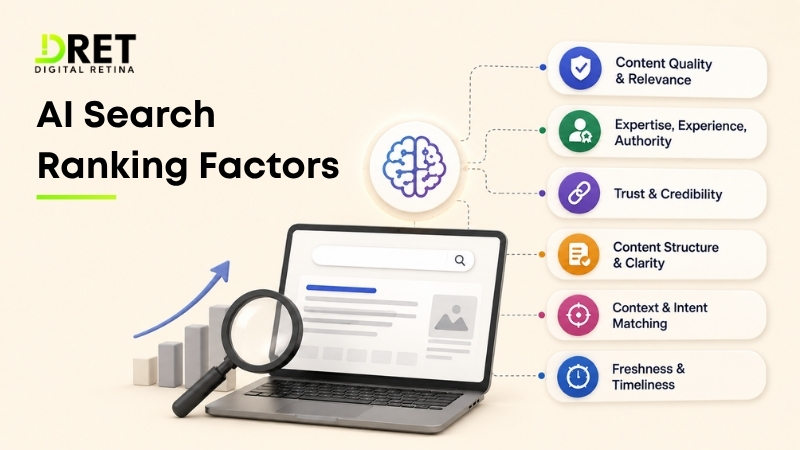
The 10 areas worth prioritizing are:
-
Search intent and relevance
-
Answer-first content
-
Topical depth
-
First-hand experience
-
E-E-A-T and author credibility
-
External authority and brand mentions
-
Entity clarity and consistency
-
Technical accessibility
-
Freshness and factual accuracy
-
Passage-level relevance and extractability
These are not ten officially confirmed AI ranking signals. They represent the areas where Google's documented Search systems, AI-search guidance, and current industry evidence overlap.
AI Search Ranking Factors at a Glance
|
Factor |
What It Means |
What to Improve |
|
Search intent |
Understanding the actual question |
Match content to the user's problem |
|
Answer-first content |
Giving the answer quickly |
Put the direct answer below the heading |
|
Topical depth |
Demonstrating subject coverage |
Build connected topic clusters |
|
First-hand experience |
Adding information from real work |
Use examples, tests, data, and observations |
|
E-E-A-T |
Demonstrating trust and expertise |
Show author credentials and evidence |
|
External authority |
Independent corroboration |
Earn relevant third-party mentions |
|
Entity clarity |
Making your brand understandable |
Keep brand and expert information consistent |
|
Technical accessibility |
Making content usable by search systems |
Fix crawling, indexing, rendering, and links |
|
Freshness |
Keeping changing information current |
Update facts and recommendations |
|
Passage relevance |
Making sections independently useful |
Answer specific questions within each section |
1. Search Intent and Relevance
AI search starts with relevance. Your content needs to solve the problem behind the query, not simply contain the keyword.
Consider the search "Shopify CRO."
The person searching could want:
-
A Shopify CRO agency
-
Conversion optimization techniques
-
Checkout improvements
-
A CRO audit
-
Shopify conversion benchmarks
-
Examples of CRO experiments
A page that repeats "Shopify CRO" throughout the copy does not necessarily satisfy any of those intents.
Google's ranking systems include RankBrain and neural matching. Google describes neural matching as helping its systems understand representations of concepts in queries and pages and match those concepts to each other.
A better content workflow
Query → Search intent → Customer problem → Direct answer → Supporting evidence
This is more useful than starting with a keyword and forcing the content around it.
From my SEO perspective, one page that completely solves a specific search problem is usually more valuable than several pages competing for the same keyword.
2. Answer-First Content
Answer-first content puts the direct answer before the background explanation.
This is one of the simplest improvements you can make to content intended for both traditional search and AI search.
Example
Question: What is Generative Engine Optimization?
Answer: Generative Engine Optimization, or GEO, is the practice of improving a brand's visibility and representation in AI-generated answers by making its information relevant, trustworthy, clearly structured, and easy to retrieve.
Then explain:
-
How GEO works
-
Where it applies
-
What content needs improvement
-
How visibility can be measured
Use this section structure
Direct answer
↓
Explanation
↓
Example or evidence
↓
Action
Google's guidance continues to emphasize helpful, reliable, people-first content rather than content created primarily to manipulate search systems.
My practical rule: If a reader has to scroll through several paragraphs before finding the answer to an H2 question, that section probably needs restructuring.
3. Topical Depth and Semantic Relevance
A website becomes more useful for AI search when it demonstrates depth around a subject rather than publishing isolated keyword-focused pages.
For example, a website targeting AI SEO could build supporting content around:
-
AI search ranking factors
-
Google AI Overviews SEO
-
ChatGPT Search
-
Generative Engine Optimization
-
Answer Engine Optimization
-
LLM SEO
-
AI citation tracking
-
Entity optimization
-
AI search analytics
These pages should have logical relationships and internal links.
What not to do
Do not create dozens of pages simply by changing the keyword.
Google's guidance for generative AI specifically warns against producing large amounts of content primarily to manipulate Search rankings.
The goal is topical completeness, not content volume.
4. First-Hand Experience
First-hand experience is one of the clearest ways to make AI-search content different from generic summaries.
Instead of repeating what everyone else says, add information that comes from doing the work:
-
SEO experiments
-
CRO tests
-
Before-and-after examples
-
Search Console observations
-
Client lessons
-
Original research
-
Screenshots
-
Failed approaches
-
Expert judgments
For example, if you recommend restructuring FAQ content, explain what you changed, why you changed it, and what you learned from the process.
This matters because AI search is already surrounded by large volumes of derivative content. If an article simply summarizes Google's documentation and several competitor articles, it gives the reader little reason to prefer it.
Google's current guidance recommends adding unique information, original research, and first-hand experience rather than simply reproducing information already available online.
From my experience working across SEO and CRO, the most useful insights often come from what did not work as expected. Those observations are usually more valuable than another generic "best practices" list.
Important E-E-A-T Rule
Do not invent client results to make an article appear more experienced.
If you have a genuine result, publish it with context.
If you do not, provide genuine professional observations instead.
That is more credible than manufacturing a percentage.
5. E-E-A-T and Author Credibility
E-E-A-T gives readers context about why your content should be trusted, but an author bio alone does not demonstrate expertise.
E-E-A-T means:
|
Element |
What It Should Show |
|
Experience |
You have actually worked with the subject |
|
Expertise |
You understand the subject deeply |
|
Authoritativeness |
Others recognize your expertise |
|
Trustworthiness |
Your information is accurate and transparent |
For expert-led content, demonstrate this through:
-
A named author
-
Relevant professional experience
-
Original observations
-
Accurate claims
-
Reliable sources
-
Clear methodology
-
Transparent limitations
For this article, Abhishek Singh, SEO & CRO Consultant with 6+ years of experience, provides relevant professional context.
But the real E-E-A-T comes from the article itself.
Credentials tell readers who you are. Evidence shows them why they should trust you.
6. External Authority and Brand Mentions
A brand becomes easier to trust when relevant third-party sources independently reinforce its expertise.
For example, if a company specializes in technical SEO, relevant references from industry publications, interviews, partnerships, research, professional profiles, and other authoritative sources can reinforce that association.
Minimum External Authority Checklist
Focus on relevant sources such as:
-
Industry publications
-
Expert interviews
-
Original research citations
-
Professional organizations
-
Industry partnerships
-
Author profiles
-
Reputable business publications
Do not turn this into a numbers game.
Ten irrelevant directory listings are not necessarily stronger than one highly relevant industry reference.
My SEO view: The strongest authority signals are the ones that make sense even when search engines are removed from the equation.
If a respected industry publication would naturally mention your expertise, that is usually a better target than creating another low-value profile simply because it offers a backlink.
7. Entity Clarity and Brand Consistency
AI systems need enough context to understand who your brand is, what it offers, who its experts are, and what subjects it is associated with.
A simple entity consistency check should cover:
|
Entity |
Minimum Check |
|
Brand name |
Same spelling everywhere |
|
Logo |
Consistent official version |
|
Description |
Core business description is consistent |
|
Services |
Primary services match across profiles |
|
Founder/experts |
Names and roles are consistent |
|
Website |
Official domain is consistently linked |
|
Social profiles |
Official profiles are identifiable |
|
Professional profiles |
LinkedIn and relevant profiles align |
|
Business profiles |
Business information is current |
|
Organization data |
Structured data matches visible information |
The exact profile mix should depend on the business.
A B2B SaaS company may prioritize LinkedIn, Crunchbase, industry directories, and review platforms.
A local healthcare business may need stronger consistency across Google Business Profile, professional profiles, local directories, and its own website.
The objective is not to create profiles everywhere. It is to create a consistent identity where your audience and industry already expect to find you.
8. Technical Accessibility
AI visibility still depends on basic technical SEO because search systems need to access and understand content before they can use it.
Google says pages need to be indexed and eligible to appear in Google Search to be eligible as supporting links in AI Overviews or AI Mode. It also recommends allowing crawling, using internal links, providing important content in text, and ensuring structured data matches visible content.
Technical Checklist
|
Area |
What to Check |
|
Crawling |
Important pages are accessible |
|
Indexing |
Valuable pages are indexed |
|
Internal links |
Important pages are well connected |
|
JavaScript |
Main content can be processed |
|
Text |
Important information is available as text |
|
Mobile |
Content works across devices |
|
Canonicals |
Duplicate URLs are controlled |
|
Structured data |
Markup matches visible content |
|
Page experience |
Pages are usable and performant |
Google's generative AI guidance also recommends following normal crawling and JavaScript SEO practices rather than creating separate technical systems specifically for AI search.
AI SEO does not replace technical SEO. It builds on it.
9. Freshness and Factual Accuracy
Freshness matters when the information itself changes, but changing the publication date is not a content strategy.
Freshness is particularly important for:
-
AI platforms
-
Google Search
-
SEO algorithms
-
Advertising platforms
-
Software
-
Pricing
-
Regulations
-
Industry benchmarks
Google documents dedicated freshness systems for queries where newer information is expected.
A meaningful content update should:
-
Correct outdated information.
-
Add new evidence.
-
Replace obsolete examples.
-
Reflect platform changes.
-
Improve recommendations.
-
Remove unsupported claims.
My approach to content updates is simple: if the reader would notice that something is outdated, update it. If only the date changed, it probably was not a meaningful update.
10. Passage-Level Relevance and Extractability
Each important section of an article should be capable of answering a specific question on its own.
Google documents passage ranking as a system that helps identify relevant passages within webpages.
That has an important implication for content structure.
Instead of:
Long introduction → multiple concepts → answer buried near the end
Use:
Question → Direct answer → Explanation → Evidence → Example
Before vs. After
|
Generic Content |
Answer-First Content |
|
"AI SEO is becoming increasingly important..." |
"AI SEO improves visibility across AI-generated search experiences by making information relevant, trustworthy, and easy to retrieve." |
|
Three paragraphs before the answer |
Answer in the first 1–2 sentences |
|
Generic best practices |
Specific actions and examples |
|
One long block of information |
Independent sections answering related questions |
|
Claims without context |
Claims supported by evidence |
|
"AI search is changing SEO" |
Explain exactly what changes and what remains the same |
This is not about writing for an AI instead of a person.
It is about making information clear enough for a person to understand and structured enough for retrieval systems to identify its relevance.
What the 10 Factors Actually Have in Common
The ten factors can be grouped into four broader areas:
|
Area |
Factors |
Core Question |
|
Relevance |
Intent, answer quality, passage relevance |
Does this answer the question? |
|
Expertise |
Experience, E-E-A-T, topical depth |
Does this source understand the subject? |
|
Authority |
Brand mentions, entities, external references |
Is there evidence supporting the source? |
|
Accessibility |
Technical SEO, freshness, structure |
Can the information be found and understood? |
This is the bigger picture.
AI search optimization is less about adding a new layer of tricks and more about improving the quality and accessibility of the information you already publish.
How to Measure AI Search Visibility
Measure AI visibility separately from traditional rankings, but connect both to traffic and business outcomes.
Google launched dedicated generative AI performance reports in Search Console on June 3, 2026. The reports cover AI Overviews and AI Mode and can show:
-
Impressions
-
Pages
-
Countries
-
Devices
-
Dates
However, the current report is primarily an impression and visibility report. Google has not yet added click and conversion metrics to this dedicated generative AI view, and the feature is being rolled out to a subset of sites.
That limitation matters.
Do not claim that Search Console can currently tell you exactly how many leads came from an AI Overview.
Practical Measurement Framework
|
Metric |
Source |
What It Tells You |
|
AI impressions |
Search Console |
AI feature visibility |
|
Appearing pages |
Search Console |
Which URLs gain AI exposure |
|
Organic clicks |
Search Console |
Traditional search traffic |
|
AI referrals |
Analytics |
Traffic where identifiable |
|
Brand mentions |
AI monitoring tools |
Brand visibility in AI answers |
|
Branded searches |
Search Console |
Demand for your brand |
|
Leads |
Analytics/CRM |
Commercial impact |
|
Revenue |
CRM/analytics |
Business value |
The key is to connect:
Visibility → Traffic → Engagement → Conversion
An AI mention is useful.
A qualified lead generated after AI-assisted discovery is much more meaningful.
What to Do First: AI Search Optimization Priorities
If you are improving an existing website, do not start by rewriting every page.
Prioritize pages that already have:
-
Strong organic impressions
-
High-value commercial intent
-
Existing authority
-
Strong topical relevance
-
Conversion potential
-
Visibility in AI features, where measurable
Then follow this sequence:
1. Identify Important Questions
Find the questions customers ask before buying, comparing, or choosing a solution.
2. Audit the Current Answer
Check whether the direct answer appears early and whether the section actually solves the user's problem.
3. Add Original Value
Include experience, examples, evidence, data, or expert judgment.
4. Strengthen Topical Coverage
Create supporting pages only when they genuinely add useful information.
5. Improve Entity Clarity
Make your organization, people, services, products, and expertise consistent.
6. Fix Technical Barriers
Check crawling, indexing, internal links, rendering, structured data, and page experience.
7. Refresh Important Content
Update information that has genuinely changed and remove unsupported claims.
8. Measure the Results
Track AI impressions where available, organic visibility, brand mentions, traffic, leads, and conversions.
AI Search Ranking Factors: Final Takeaway
The most sustainable way to improve AI visibility is to become a better source, not to chase an unconfirmed ranking formula.
Google has not published a separate AI ranking score or a secret checklist for AI Overviews and AI Mode. Its current guidance says existing SEO fundamentals remain relevant, while its generative AI documentation emphasizes crawlability, helpful content, unique information, and strong user experience.
The practical model is straightforward:
Answer the question.
Add information others do not have.
Demonstrate real expertise.
Build credible external authority.
Make your entities clear.
Keep your technical foundation strong.
Keep important information accurate and current.
Make every important section independently useful.
A page does not need to be "optimized for AI" in isolation.
It needs to be the best available answer for the user and a credible source for the search system.
That is the foundation behind AI SEO, AEO, GEO, LLM SEO, and long-term AI search visibility.
Ready to Implement These Strategies?
Our team of digital marketing experts can help you navigate these trends and create a winning strategy.