

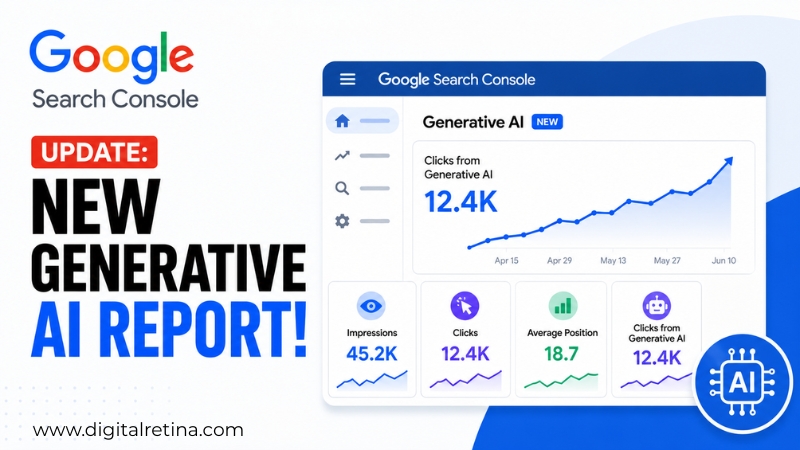
On June 3, 2026, Google officially rolled out a major Google Search Console update, introducing a new generative AI reporting feature that gives publishers visibility into AI-powered search experiences, including AI Overviews and Google AI Mode.
The announcement was published on the Google Search Central Blog by Hillel Maoz and Moshe Samet and marks one of the biggest reporting changes inside Search Console since Core Web Vitals.
Unlike traditional Search Analytics data, this new report focuses primarily on impression-level visibility from AI-generated search experiences, helping site owners understand how often their content appears inside generative AI surfaces.
However, there’s one important limitation many marketers are missing:
At launch, the report currently shows impressions only. Click-level reporting is not yet included.
That distinction matters because several early articles incorrectly claimed websites could track AI Overview clicks. Based on Google’s current documentation and preview screenshots, click data is unavailable in this version of the report.
What Is the Generative AI Performance Report?
The new generative AI performance section in Google Search Console helps publishers monitor how often their content appears inside AI-powered search features.
These surfaces include:
- AI Overviews
- Google AI Mode
- AI-generated summaries
- Conversational search experiences
- Generative AI Discover features
Before this update, publishers had almost no visibility into how AI-enhanced search experiences affected search visibility.
This reporting update changes that by introducing dedicated impression reporting for generative AI search surfaces.
Google also confirmed that the reporting extends beyond Search and includes generative AI features inside Discover.
This Google Search Console update is particularly important because it represents Google’s first major attempt to give publishers measurable visibility into AI-driven search exposure.
What Data Does the Report Show?
Currently, the report focuses primarily on impression-level visibility data from AI-powered search experiences. According to Google’s documentation and early interface previews, the report currently supports reporting across these dimensions:
- Pages
- Countries
- Devices
- Dates
Importantly, the report does not currently include:
- Clicks,
- CTR,
- conversions,
- or query-level reporting.
The absence of query data is already becoming one of the biggest complaints among SEO professionals because it limits deeper optimization analysis.
Several early articles incorrectly claimed websites could track AI Overview clicks and keyword performance, but Google’s current implementation is significantly more limited.
At this stage, the report is best viewed as a high-level AI visibility reporting tool rather than a complete AI traffic analytics platform.
UK Rollout Limitation
Another important detail often overlooked: As of June 2026, the rollout is currently limited to a subset of UK-based Search Console properties. Google has not yet confirmed a full global rollout timeline.
That means many publishers outside the UK may not see the feature inside their Search Console accounts yet. The UK-first rollout is also linked to regulatory requirements from the UK’s Competition and Markets Authority (CMA), which pushed for stronger publisher controls over AI-generated content usage.
For context, Microsoft launched AI performance reporting in Bing Webmaster Tools in February 2026 with global availability from day one. Google’s phased UK-first approach appears tied more closely to regulatory obligations than technical readiness.
Google is likely using the phased launch to:
- test reporting accuracy,
- evaluate publisher feedback,
- and refine impression thresholds before wider availability.
If you don’t see the report yet, that does not necessarily mean your site is ineligible.
Historical Data Availability
Google confirmed that historical data in the report currently dates back to May 18, 2026. This gives publishers a relatively small but useful initial data window for identifying:
- visibility shifts,
- AI search exposure,
- and emerging traffic patterns.
Because the dataset is still limited, marketers should avoid drawing aggressive long-term conclusions from early impression changes alone.
New AI Blocking Controls in Search Console
Alongside the reporting update, Google also introduced new AI feature controls for publishers. This is one of the most important additions in the announcement — yet many summaries barely mention it. Website owners can now use Search Console controls to:
- opt out of certain AI-powered search features,
- restrict generative AI usage,
- and manage how their content appears in AI-generated experiences.
In practical terms, this acts as an AI blocking toggle for eligible AI search surfaces. According to Google, opting out may remove your content from some generative AI experiences, but it does not directly affect standard organic rankings in traditional Search results.
Important: this opt-out applies only to Google Search products, including AI Overviews, AI Mode, and Discover AI experiences. It does not prevent your content from appearing inside Google’s Gemini app.
Google also confirmed that these AI control settings will only begin taking effect from June 17, 2026. Until then, publishers effectively have a configuration window where settings can be adjusted without any live ranking or visibility impact.
This creates an important strategic decision for publishers:
- maximize AI visibility,
- or restrict AI summarization of content.
Large publishers will likely test both approaches over the next year.

Discover Generative AI Reporting Is Also Included
Most discussions around this update focus only on Search. However, Google also launched reporting tied to generative AI experiences inside Discover.
This matters because Discover traffic behaves very differently from traditional search traffic. For publishers heavily dependent on Discover visibility, the new reporting may eventually help identify:
- AI-driven content exposure,
- visibility trends,
- and recommendation behavior changes.
At the moment, reporting depth remains limited, but the inclusion itself signals Google’s broader AI integration strategy.
Why This Google Search Console Update Matters for SEO
This update confirms that search visibility is no longer limited to traditional rankings. Modern SEO increasingly involves:
- AI-generated visibility,
- entity authority,
- topical trust,
- and brand recognition.
Google’s systems are evolving toward answer-driven experiences where users may interact with summaries before visiting a website. That changes how publishers should measure success. Context matters here.
Google reports that AI Overviews now reaches more than 2.5 billion monthly users, while AI Mode has surpassed 1 billion monthly users. That scale alone makes AI search visibility a measurement priority for publishers rather than an experimental SEO trend.
For SEO professionals, this Google Search Console update confirms that AI visibility reporting will become a core part of future organic search analysis. Impressions inside AI experiences may still influence:
- brand awareness,
- future branded searches,
- assisted conversions,
- and audience trust.
This is why measuring only direct clicks can create an incomplete SEO picture moving forward.
How to Interpret AI Impressions Correctly
One mistake many marketers will make is treating AI impressions exactly like traditional search impressions.They are not the same. An AI Overview impression may represent:
- partial content usage,
- citation visibility,
- contextual summarization,
- or brand exposure inside generated answers.
That means impression growth does not automatically translate into traffic growth. In several SEO consulting projects I’ve reviewed recently, highly authoritative informational pages gained visibility in AI experiences while traditional clicks remained flat. That doesn’t necessarily indicate failure. Instead, it reflects how AI-powered search changes user behavior. The bigger opportunity may come from:
- stronger brand recall,
- higher topical authority,
- and improved future conversion likelihood.
What This Means for Content Strategy
This update reinforces a major shift already happening across SEO: Generic, low-value content is becoming less effective. Google’s AI systems increasingly prioritize:
- firsthand expertise,
- clear answers,
- original research,
- expert commentary,
- and trustworthy sources.
From what I’ve observed across client campaigns, pages performing best in AI-enhanced environments usually have:
- strong author credibility,
- practical examples,
- unique insights,
- and clear topical depth.
This is where EEAT becomes more than just a Google guideline — it becomes a visibility advantage. Content designed purely around keyword insertion is far less likely to earn long-term AI visibility.
Industry experts including Aleyda Solís, Glenn Gabe, and Brodie Clark have also highlighted how AI-driven search is shifting optimization priorities away from pure rankings and toward visibility, authority, and trust signals.
Why FAQ Schema Matters for AI Overviews
For articles covering technical SEO updates like this one, structured data can improve how content is interpreted by Google’s systems. In particular, FAQPage schema helps search engines clearly identify question-and-answer content that may be useful inside AI-generated summaries and People Also Ask results.
While schema markup does not guarantee inclusion inside AI Overviews, properly structured FAQ content can improve machine readability and increase eligibility for enhanced search features.
For this article, implementing:
- FAQPage schema,
- Article schema,
- author information,
- and datePublished/dateModified fields
would strengthen freshness and trust signals for both traditional Search and AI-driven experiences.
Example FAQPage JSON-LD structure:
{
"@context": "https://schema.org",
"@type": "FAQPage",
"mainEntity": [
{
"@type": "Question",
"name": "Does the new report show AI clicks?",
"acceptedAnswer": {
"@type": "Answer",
"text": "No. As of June 2026, the report currently shows impressions only."
}
}
]
}
FAQs
What is the latest Google Search Console update?
The latest Google Search Console update, announced on June 3, 2026, introduces a dedicated Generative AI Performance Report. The feature helps publishers understand how often their content appears inside AI-powered search experiences such as AI Overviews and Google AI Mode using impression-level reporting.
Google also launched new AI content blocking controls alongside the report, allowing publishers to manage participation in certain AI-powered Search experiences.
Does the new report show AI clicks?
No. As of June 2026, the report currently shows impressions only. Click tracking is not yet available.
Is the report available globally?
No. The initial rollout appears limited to selected UK-based Search Console properties.
What date does historical data start from?
Current reporting data goes back to May 18, 2026.
Can publishers block AI usage of their content?
Yes. Google introduced new AI blocking controls that allow publishers to opt out of certain AI-powered search experiences.
Does opting out affect normal Google rankings?
According to Google, opting out of AI features should not directly impact standard organic rankings.
Does the update include Discover reporting?
Yes. Google also launched reporting tied to generative AI experiences inside Discover.
Why can't I see the Generative AI report in my Search Console?
There are three common reasons:
The report is currently rolling out in phases, starting with selected UK-based properties, so your account may not have access yet.
Your website may not have generated enough impressions in AI-powered search experiences to meet Google’s reporting threshold.
Your site may have previously opted out of generative AI search features through Search Console controls.
If the report is unavailable, Google recommends checking your AI feature settings and waiting for broader rollout availability.
Final Thoughts
The latest Google Search Console update — the new generative AI performance report — is still in its early stages, but it signals a major transition in how search visibility will be measured moving forward.
Right now, the report is limited:
- impressions only,
- UK rollout first,
- and relatively small historical datasets.
But the direction is clear.
Google is building infrastructure for AI-first search reporting.
For SEO professionals, publishers, and content teams, the biggest takeaway is simple:
Future visibility will depend less on producing massive volumes of content — and more on creating trustworthy, experience-driven resources that AI systems consider reliable enough to surface.
The websites that adapt early to this shift will likely hold a strong advantage as AI-powered search continues evolving.
About the Author
Achin Sharma is a Digital Marketing and SEO Consultant with 8+ years of experience working with SaaS, healthcare, education, and local business brands. He specializes in technical SEO, AI search optimization, and organic growth strategy.
Ready to Implement These Strategies?
Our team of digital marketing experts can help you navigate these trends and create a winning strategy.