
Author: Abhishek Singh | SEO & CRO Consultant | 6+ Years of Experience
The mobile app development cost in India in 2026 generally ranges from ₹2 lakh to ₹1 crore+, depending on the app's complexity, features, platform, integrations, security, and development team. A basic MVP may cost ₹2–6 lakh, a mid-level business app ₹6–15 lakh, and a complex or enterprise application ₹15 lakh to ₹1 crore or more.
The final app development cost depends less on the number of screens and more on what the app needs to do, how many users it must support, and how much custom technology is required.
Mobile App Development Cost in India in 2026
Businesses can use the following ranges as an initial budgeting guide:
|
App Type |
Estimated Cost |
Typical Timeline |
|
Basic / MVP app |
₹2–6 lakh |
1–3 months |
|
Mid-level app |
₹6–15 lakh |
3–6 months |
|
Complex app |
₹15–50 lakh+ |
5–9 months |
|
Enterprise / regulated app |
₹50 lakh–₹1 crore+ |
8–12+ months |
These are indicative ranges, not fixed quotations. A simple business app with limited functionality can stay near the lower end, while applications involving real-time systems, multiple user roles, advanced security, AI, financial transactions, or large-scale infrastructure can move substantially higher.
For example, a ₹4 lakh MVP might cover user registration, a basic dashboard, profile management, notifications, and a limited backend. It would not normally cover the same scope as a ₹15 lakh marketplace with customers, vendors, payments, chat, order management, and an admin panel.
App Development Cost by Industry
Your industry can significantly affect the budget because different applications have different security, compliance, integration, and workflow requirements.
|
Industry |
Typical Cost Range |
Major Cost Drivers |
|
eCommerce |
₹10–30 lakh |
Catalogue, payments, orders, inventory |
|
Food delivery |
₹12–35 lakh |
Customer, restaurant, delivery workflows, maps |
|
Healthcare |
₹15–50 lakh+ |
Patient data, appointments, security, integrations |
|
Fintech |
₹25 lakh–₹1 crore+ |
Security, payments, compliance, transaction systems |
|
EdTech |
₹8–30 lakh |
Courses, video, assessments, subscriptions |
|
Logistics |
₹15–40 lakh+ |
GPS, tracking, driver workflows, APIs |
|
Ride-hailing |
₹20–50 lakh+ |
Real-time location, matching, payments, notifications |
These figures are broad planning ranges. Fintech applications often have a higher starting point because payment and transaction infrastructure, stronger security controls, and compliance requirements can be part of the product from the beginning. Healthcare applications can also become significantly more expensive when they involve complex integrations, sensitive patient information, or extensive compliance requirements.
The actual mobile application development cost should therefore be estimated after defining the industry's specific workflows and technical requirements.
How Much Does It Cost to Develop an App by Complexity?
Basic or MVP App: ₹2–6 Lakh
A basic application focuses on the core functionality needed to launch an initial product.
It may include:
-
User registration and login
-
User profiles
-
Basic dashboard
-
A limited number of screens
-
Forms or content
-
Push notifications
-
Simple backend
-
Basic admin functionality
For example, if you budget ₹5 lakh for an MVP, the priority should be the features necessary to validate the business idea rather than advanced functionality that can be added later.
Mid-Level App: ₹6–15 Lakh
A mid-level application usually requires more workflows and integrations.
It may include:
-
Custom UI/UX
-
Multiple user roles
-
Payment gateway
-
Search and filters
-
API integrations
-
Admin dashboard
-
Notifications
-
Analytics
-
Database management
A ₹10 lakh budget could support a more complete business application, but the exact scope would still depend on the number of platforms, integrations, and custom features.
Complex App: ₹15–50 Lakh+
Complex applications require more development, testing, infrastructure, and technical planning.
Examples include:
-
Multi-vendor marketplaces
-
Delivery platforms
-
Ride-booking apps
-
Advanced healthcare applications
-
Fintech platforms
-
Real-time communication apps
-
AI-enabled applications
-
Enterprise business applications
A ₹30 lakh project, for example, may include multiple user applications, advanced backend systems, third-party APIs, real-time functionality, stronger security, and extensive testing.
Enterprise App: ₹50 Lakh–₹1 Crore+
Enterprise applications often involve large user bases, complex integrations, custom infrastructure, extensive security requirements, and multiple business workflows.
Fintech, healthcare, logistics, large marketplaces, and AI-driven platforms can fall into this category.
At this level, the cost to develop an app should be estimated from detailed technical requirements rather than a generic industry average.
Native vs. Cross-Platform App Development Cost
The technology approach can also change the budget.
|
Development Approach |
Indicative Cost |
Best For |
|
Native Android |
₹3–20 lakh+ |
Android-focused products |
|
Native iOS |
₹3–20 lakh+ |
iOS-focused products |
|
Native Android + iOS |
₹8–40 lakh+ |
Separate platform experiences |
|
Flutter / React Native |
₹5–30 lakh+ |
Businesses targeting both platforms |
Cross-platform development can reduce duplicated development work because a shared codebase can support multiple platforms. In suitable projects, this can lower development time and cost compared with building two completely separate native applications.
However, Flutter or React Native is not automatically cheaper for every project. Apps requiring highly platform-specific functionality, advanced device capabilities, or specialized performance may still benefit from native development.
Developer and Agency Hourly Rates in India
The development team's experience and engagement model also influence app development pricing.
|
Developer / Team Type |
Approx. Hourly Rate |
|
Junior freelancer |
₹500–₹1,000/hour |
|
Mid-level developer / small team |
₹1,200–₹2,500/hour |
|
Senior developer / specialist |
₹2,500–₹4,500+/hour |
|
Professional development agency |
₹2,000–₹5,000+/hour |
Hourly pricing should not be used as the only way to compare vendors. A senior team may charge more per hour but complete complex work faster and require less rework.
When comparing quotes, look at the total project cost, team composition, experience, scope, testing, support, and ownership terms, not just the hourly rate.
What Do Individual App Features Cost?
Individual features can have very different development requirements. The following figures can help businesses understand how individual requirements affect the budget:
|
Feature |
Indicative Cost |
|
Social login |
₹10,000–₹20,000 |
|
Payment gateway |
₹20,000–₹60,000 |
|
Google Maps / location integration |
₹30,000–₹50,000 |
|
Push notifications |
₹10,000–₹25,000 |
|
Basic chat |
₹30,000–₹80,000 |
|
Advanced real-time tracking |
₹75,000–₹2 lakh+ |
|
Admin dashboard |
₹50,000–₹2 lakh+ |
|
Third-party API integration |
₹20,000–₹75,000+ |
These are planning estimates rather than fixed prices. A payment gateway, for example, may be relatively straightforward in one application but require considerably more work when it involves subscriptions, refunds, multiple payment methods, reconciliation, or complex transaction workflows.
The same applies to maps and APIs. A basic location feature may have a modest implementation cost, while real-time tracking with background location, route management, driver status, and live updates can require considerably more development.
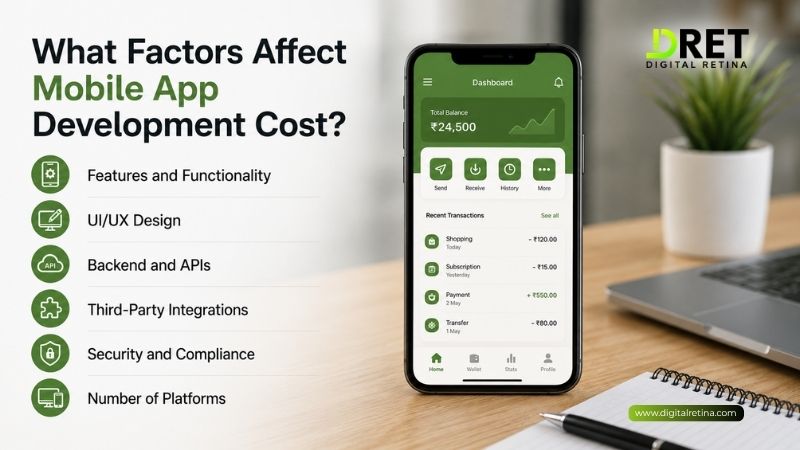
What Factors Affect Mobile App Development Cost?
Several factors can change the final budget.
Features and Functionality
More complex workflows require more development and testing. Real-time chat, location tracking, payment processing, AI features, recommendation systems, and multi-vendor functionality generally require more work than basic content or form-based features.
UI/UX Design
A simple interface costs less to design than a fully custom experience involving detailed prototypes, animations, custom components, and multiple user journeys.
Backend and APIs
The backend manages authentication, databases, business logic, APIs, permissions, notifications, and data processing. Applications requiring high scalability or real-time functionality generally need more sophisticated backend architecture.
Third-Party Integrations
Maps, payment gateways, CRM systems, analytics platforms, shipping services, communication tools, and other APIs add implementation and testing requirements.
Security and Compliance
Apps handling financial transactions, healthcare information, or other sensitive data may require additional security measures, testing, access controls, and compliance work.
Number of Platforms
Building for Android only is different from developing and maintaining native Android and iOS applications separately. Cross-platform technology may reduce duplicated work where it is technically suitable.
Hidden and Recurring Costs Businesses Should Budget For
The initial development quotation is not the only expense. Businesses should also plan for recurring operating costs after launch.
|
Cost Item |
Typical Cost |
|
Apple Developer Program |
US$99/year |
|
Google Play Console |
US$25 one-time |
|
Cloud hosting |
₹5,000–₹50,000+/month |
|
Third-party APIs |
₹15,000–₹60,000+/month |
|
SMS / email services |
₹2,000–₹20,000+/month |
|
Monitoring / security tools |
₹3,000–₹25,000+/month |
These are broad planning ranges because usage can vary significantly. A small application with limited traffic may spend much less, while an app with thousands or millions of users can have substantially higher infrastructure and API expenses.
Third-party services can become recurring expenses as usage grows. Instead of treating these as one-time development costs, include them in the application's operating budget.
App Maintenance Cost After Launch
A practical planning benchmark is to reserve around 15–20% of the original development cost per year for maintenance and support, although actual requirements vary by application.
For example:
-
₹5 lakh app → approximately ₹75,000–₹1 lakh annually
-
₹10 lakh app → approximately ₹1.5–₹2 lakh annually
-
₹30 lakh app → approximately ₹4.5–₹6 lakh annually
Maintenance can include bug fixes, OS compatibility updates, security patches, server management, performance improvements, app-store updates, and minor changes.
Major new features should normally be treated as a separate development budget.
How to Read a Mobile App Development Quote
A low quote is not necessarily a better quote. Before signing an agreement, check whether the proposal clearly specifies:
Scope: What features and workflows are included?
Platforms: Does the price cover Android, iOS, or both?
UI/UX: Are research, wireframes, prototypes, and final designs included?
Backend: Is backend development included or priced separately?
Testing: Does the quotation include QA and device testing?
Third-party services: Who pays for APIs, hosting, payment services, and other external tools?
Ownership: Will you receive the source code, design files, credentials, and documentation?
Support: How long is post-launch support included?
Change requests: What happens if requirements change during development?
A quotation that does not clearly explain these areas should be reviewed carefully before you compare it with another vendor.
How Businesses Can Reduce App Development Cost
The best way to control the app development budget is to control the scope.
Start with the features that directly support your primary business objective. Launch an MVP, collect user feedback, and then invest in additional functionality based on actual demand.
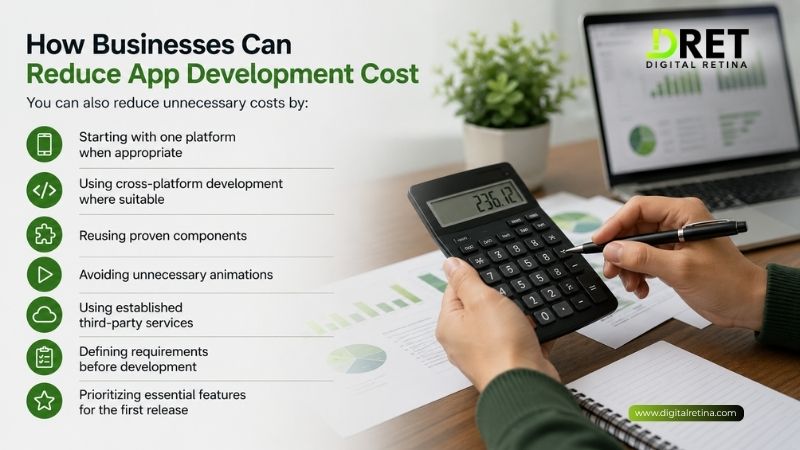
You can also reduce unnecessary costs by:
-
Starting with one platform when appropriate
-
Using cross-platform development where suitable
-
Reusing proven components
-
Avoiding unnecessary animations
-
Using established third-party services
-
Defining requirements before development
-
Prioritizing essential features for the first release
The objective should not be building the cheapest application. It should be building the right first version without paying for unnecessary complexity.
Frequently Asked Questions
How much does a basic app cost in India?
A basic mobile app can cost around ₹2–6 lakh in India in 2026 when it has limited screens, straightforward functionality, and a relatively simple backend. Additional integrations or advanced features can increase the budget.
How long does it take to build an app in India?
A basic MVP may take 1–3 months, a mid-level application around 3–6 months, and a complex application 5–9 months or more. Enterprise products can take 8–12 months or longer depending on scope and approvals.
Is app development cheaper in India than in the US?
India generally offers lower development rates than the US and several other Western markets, but the final saving depends on the team's experience, project scope, technology, and quality requirements. Businesses should compare complete project scope rather than hourly rates alone.
Should I hire a freelancer, agency, or in-house team?
A freelancer can work well for a small and clearly defined project. An agency can be more suitable when you need UI/UX, development, QA, backend, project management, and post-launch support under one team. An in-house team makes more sense when mobile development is a long-term core business capability.
Is Flutter or React Native cheaper than native development?
It can be, particularly when the same product needs to run on both Android and iOS. A shared codebase can reduce duplicated development work. However, the right choice depends on the application's functionality and technical requirements.
What is the biggest factor affecting app development cost?
The biggest factor is usually scope and functionality. Features such as real-time tracking, payments, multiple user roles, complex backend systems, AI, advanced security, and third-party integrations can significantly increase development effort.
Final Thoughts
The mobile app development cost in India in 2026 can start around ₹2 lakh for a focused MVP and exceed ₹1 crore for complex enterprise or regulated applications. Most business apps fall somewhere between these extremes, depending on features, platforms, integrations, design, backend requirements, security, and development resources.
Before requesting a quotation, define your MVP, identify your target platform, list the essential integrations, and decide what needs to be included after launch. Then compare vendors based on scope, expertise, ownership, support, and total cost rather than choosing the lowest number.
If you are planning a mobile application, the next practical step is to prepare a feature list, target platform, user roles, integrations, and expected launch timeline. A development team can use these requirements to provide a more realistic project estimate instead of giving you a generic per-app price.
Also Read This Article: https://digitalretina.in/blog/mobile-app-development-for-startups
Ready to Implement These Strategies?
Our team of digital marketing experts can help you navigate these trends and create a winning strategy.