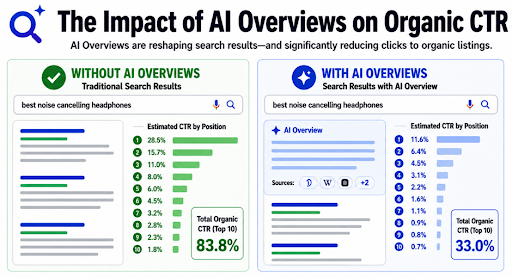
Google Search has changed significantly with the rollout of AI Overviews. For decades, SEO professionals focused on one primary objective: ranking on the first page of Google to maximize organic traffic. A higher ranking typically resulted in more clicks, making organic Click-Through Rate (CTR) one of the most important SEO metrics.
Today, that relationship is changing.
Google's AI-powered search experience now provides users with concise, AI-generated summaries directly within the search results. Instead of visiting multiple webpages to research a topic, users can often find the essential information without leaving the search page. As a result, many informational queries are experiencing a noticeable decline in organic click-through rates (CTR), as fewer users need to click through to individual websites for basic answers.
However, lower CTR doesn't mean SEO is dead. It means the way users search and the way websites earn clicks has fundamentally evolved. Businesses now need to optimize not only for search rankings but also for AI-generated search experiences.
What Is Organic CTR?
Organic Click-Through Rate (CTR) is one of the most important SEO metrics used to measure how often users click on your website after seeing it in Google's organic (non-paid) search results.
In simple terms, Organic CTR tells you how effective your search listing is at attracting clicks. Every time your webpage appears in Google Search, it counts as an impression. When a user clicks on your organic listing and visits your website, it counts as a click.
CTR shows the percentage of impressions that result in clicks. A higher CTR indicates that your page title, meta description, URL, and search position are compelling enough to encourage users to choose your website over other search results.
Organic CTR Formula
The formula for calculating Organic Click-Through Rate is:
CTR = (Organic Clicks ÷ Organic Impressions) × 100
Example
Imagine your blog post appears in Google Search 50,000 times during one month.
-
Organic Impressions: 50,000
-
Organic Clicks: 4,000
The calculation would be:
CTR = (4,000 ÷ 50,000) × 100 = 8%
This means that 8 out of every 100 users who saw your page in the search results clicked on it.
What Are AI Overviews?
Search summaries are short explanations shown at the top of Google's search results for many informational and research-based queries.
Instead of simply listing websites, Google analyzes multiple trusted sources and creates a summarized answer that addresses the user's question directly.
A typical AI Overview may include:
-
A short explanation
-
Key points
-
Step-by-step instructions
-
Comparison tables
-
Related follow-up questions
-
Links to supporting sources
Unlike Featured Snippets, which usually pull content from one webpage, search summaries combine information from multiple authoritative websites into one response.
This significantly changes how users interact with search results.
How AI Overviews Are Changing User Behavior
Google's AI Overviews have significantly changed the way people search for and consume information online. Traditionally, users relied on multiple websites to understand a topic. They searched on Google, opened several results, compared different sources, and returned to Google if they needed additional information. This process generated traffic for many websites because users needed to explore different perspectives before finding a complete answer.
Today, the search experience is much shorter. For many informational queries, Google displays a summary at the top of the search results. Instead of showing only a list of links, Google analyzes information from multiple trusted sources and presents a concise explanation. Users can quickly understand the basics of a topic without visiting several websites.
This shift has changed user behavior in several ways. Users spend less time browsing multiple pages, click fewer organic search results, and increasingly rely on AI-generated summaries for quick answers. As a result, many searches now become zero-click searches, where the user's question is answered directly on Google without visiting another website.
However, these AI-generated summaries usually satisfy users who are only looking for basic information. When users need detailed explanations, real-world examples, expert opinions, downloadable resources, or step-by-step guidance, they are still more likely to click through to high-quality websites.
Traditional Search vs. AI-Powered Search
|
Traditional Search Experience |
AI-Powered Search Experience |
|
Google displayed mainly organic search results. |
Google often displays an AI Overview above organic results. |
|
Users visited multiple websites to gather information. |
Users often receive the answer directly on Google's search results page. |
|
Information was collected from different articles. |
Google combines information from multiple trusted sources into one summary. |
|
Users compared several websites before reaching a conclusion. |
Many users stop searching after reading the AI Overview. |
|
Multiple websites received traffic from one search query. |
Fewer websites receive clicks, especially for informational searches. |
|
Ranking #1 usually generated the highest CTR. |
Ranking #1 does not guarantee the highest CTR because AI Overviews appear first. |
|
Users spent more time researching online. |
Users find answers more quickly, reducing the number of clicks. |
|
Organic traffic was the primary outcome of successful SEO. |
Visibility, authority, and creating unique content are becoming just as important as clicks. |
Why AI Overviews Reduce Organic CTR
1 Users Receive Answers Directly on Google
One of the biggest changes brought by AI Overviews is that users can now get complete answers directly on Google without visiting multiple websites. Google uses AI to summarize information from trusted sources and show it at the top of the search results. This makes the search process faster, but it also reduces the need to click on individual webpages.
For example, if a user searches “What is cloud computing?”, earlier they would have to open different websites to understand the topic. One article might explain the definition, another might describe service models like IaaS, PaaS, and SaaS, while another might list benefits such as scalability, cost efficiency, and flexibility. The user had to compare multiple pages to build a complete understanding.
As a result, many users feel no need to open additional websites because their question is already answered. This behavior is known as a “zero-click search,” where the user gets all required information directly on the search results page.
However, users still click on websites when they need deeper information such as tutorials, real-life examples, pricing comparisons, or step-by-step guides. This shows that while these AI-generated summaries are effective for basic knowledge, detailed and practical content is still valuable and necessary for users who want to learn more deeply.
How This Affects Organic CTR
This shift in user behavior directly impacts organic click-through rates (CTR). Even when a website continues to rank on the first page of Google, users are now more likely to get their answers directly from the summary shown in search results instead of clicking on organic listings.
As a result, a page may still receive a similar or even higher number of impressions because it appears in search results, but the number of clicks often decreases. This happens because users feel less need to visit external websites after reading the AI-generated summary.
Overall, this leads to a decline in organic CTR even when rankings remain unchanged. In other words, visibility on Google may stay strong, but actual website traffic can reduce because more user queries are being satisfied directly within the search results pag
2. Why AI Overviews Appear Most Often for Informational Searches
One of the biggest impacts of Google's AI Overviews is on informational search queries. These are searches where users want to learn about a topic, understand a concept, or compare different ideas rather than make a purchase or complete a specific action.
Informational search queries are the most likely to trigger Google's AI-generated search summaries because they rely on widely available and verified information. By combining insights from multiple trusted sources, Google can present a concise answer directly in the search results, reducing the need for users to click through to individual websites.
Some common informational searches include:
-
What is digital marketing?
-
How does blockchain work?
-
Difference between SEO and PPC
-
What is an API?
-
What is machine learning?
-
How does cloud computing work?
These topics are relatively easy for AI to summarize because the core information is available across thousands of reliable websites.
Why Informational Queries Are Most Affected
Before AI Overviews, users typically had to visit several websites to understand a topic.
For example, someone searching "What is an API?" might open different articles to learn:
-
The definition of an API
-
How APIs work
-
Different types of APIs
-
Real-world examples
-
Benefits of using APIs
Each website provided part of the answer, so users often clicked multiple search results before fully understanding the topic.
Today, Google can combine this information into a single AI-generated summary displayed directly on the search results page.
For many users, this summary is enough. Since they already have the information they were looking for, they often leave Google without clicking on any website.
Example: Difference Between SEO and PPC
Suppose someone searches:
"Difference Between SEO and PPC."
A few years ago, they might have visited several blogs to compare the two marketing strategies. They would read different explanations, compare advantages and disadvantages, and decide which approach best suited their business.
Today, Google AI Overview may instantly display a comparison like this:
|
SEO |
PPC |
|
Organic traffic |
Paid traffic |
|
Long-term results |
Immediate visibility |
|
No cost per click |
Requires advertising budget |
|
Builds authority over time |
Delivers quick traffic |
|
Takes time to show results |
Results begin as soon as the campaign starts. |
Within a few seconds, users can clearly understand the key differences between SEO and PPC.
If their goal was simply to compare the two, they may not need to click on any website.
However, if they want to learn how to choose between SEO and PPC, calculate ROI, see real campaign examples, or understand which strategy is better for a specific business, they are much more likely to visit a detailed article.
Also Read : PPC Strategy Step-by-Step PPC Marketing Guide for 2026
Why CTR Declines for Informational Content
Because AI-generated summaries answer many informational questions directly on Google's search results page, users have fewer reasons to click on organic listings.
This creates a noticeable trend:
-
Websites continue to appear in search results and receive impressions.
-
However, fewer users click because their questions have already been answered.
-
As a result, organic click-through rates (CTR) decline, especially for articles that only explain basic concepts.
For example, a website ranking #1 for "Benefits of Email Marketing" may still appear prominently in search results. However, if Google's AI Overview already lists the major benefits—such as higher customer engagement, improved conversions, cost-effectiveness, personalization, and automation—many users may stop reading after the summary instead of visiting the website.
Ranking #1 Doesn't Guarantee the Highest CTR
In the past, ranking #1 on Google usually resulted in the highest organic click-through rate (CTR) because the top result was the first thing users saw. Today, search results have changed significantly. Google often displays Sponsored Ads, AI Overviews, Featured Snippets, videos, and People Also Ask sections before organic listings. As a result, even the #1 organic result may appear much lower on the page, reducing its visibility and clicks.
Example
Suppose your website ranks #1 for "Content Marketing Strategy." Before this feature, users were likely to click your article immediately. Today, they may first read the summary shown on Google's search results page, which explains the key strategies. If the summary answers their question, they may never scroll down to the organic results. Consequently, your website still ranks first but receives fewer clicks than it would have in the past.
More Impressions, Lower CTR
Many SEO professionals are noticing an interesting trend in Google Search Console: website impressions are increasing, but click-through rates (CTR) are declining. At first glance, this may seem like a sign that SEO performance is worsening, but that is not always the case.
An impression is recorded whenever your webpage appears in Google's search results, while a click is counted only when a user visits your website. CTR is the percentage of impressions that result in clicks.
|
Month |
Impressions |
Clicks |
CTR |
|
January |
120,000 |
8,400 |
7.0% |
|
June |
165,000 |
8,100 |
4.9% |
In this example, impressions increased from 120,000 to 165,000, showing that the website appeared in search results more often. However, clicks decreased slightly from 8,400 to 8,100, causing the CTR to drop from 7.0% to 4.9%.
This does not necessarily mean the website lost rankings or that its SEO strategy became less effective. Instead, it reflects changes in user behavior caused by search result summaries. Users still see the website in search results, but many first read the summary shown by Google. If the summary answers their question, they may leave without clicking any organic result
Example
Suppose your article ranks for “Benefits of Social Media Marketing.” Google may display a summary of key benefits such as increased brand awareness, improved customer engagement, targeted advertising, and higher website traffic. Users searching for a quick answer may find this summary sufficient and never visit your page. Your article still receives an impression because it appears in the search results, but it does not receive a click, lowering your CTR.
Does Lower CTR Mean SEO Is Losing Value?
Imagine two blogs targeting the keyword "Content Marketing Strategy."
Blog A contains a basic article covering:
-
The definition of content marketing
-
Its benefits
-
General best practices
Although the information is accurate, it is similar to hundreds of other articles available online. Because the content is widely available, Google's AI Overview can easily summarize it, reducing the need for users to visit the website.
Blog B, however, provides much deeper and more practical information, including:
-
Downloadable content planning templates
-
Real campaign case studies
-
Industry benchmarks and statistics
-
Performance data and results
-
Step-by-step implementation guides
-
Common mistakes and lessons learned
Google may summarize the main ideas from Blog B, but it cannot include every template, chart, example, or detailed explanation in the AI Overview. Users who want to apply the strategy, download resources, or learn from real-world experiences are much more likely to click through to the website.
Why Some Websites Continue to Earn Clicks
With the introduction of Google AI Overviews, many website owners worry that users will stop clicking on organic search results because AI-generated answers now appear directly at the top of the search page. While these summaries can satisfy many basic informational queries, they do not eliminate the need for high-quality, in-depth content.
Google's AI-powered search experience is designed to deliver quick answers by combining information from multiple trusted sources. Its purpose is to help users understand a topic more efficiently, not to replace comprehensive resources. For simple questions—such as definitions, benefits, or basic concepts—a concise summary may be sufficient. However, when users need detailed explanations, step-by-step guidance, practical advice, expert insights, or real-world examples, they still rely on websites that provide complete and trustworthy information.
This creates a significant opportunity for publishers who produce original, experience-driven content. Rather than competing with AI-generated summaries, focus on creating resources that offer unique value, such as case studies, original research, practical frameworks, expert analysis, downloadable templates, and firsthand experiences. These types of content provide information that cannot be fully captured in a brief summary, giving users a compelling reason to visit your website.
Example: Email Marketing Strategy
Imagine a user searches for "Email Marketing Strategy."
What the AI Overview Provides
Google's AI Overview may display a concise summary covering:
-
What email marketing is
-
Why businesses use email marketing
-
Basic steps for creating an email campaign
-
General best practices
For someone who only wants a basic understanding, this summary may answer their question without requiring them to visit a website.
Why Users Still Click a Website
Now imagine a website that goes beyond these basic explanations and includes:
-
A step-by-step email marketing framework
-
Real campaign examples with screenshots
-
Email automation workflows
-
Subject line templates
-
A downloadable campaign checklist
-
Open rate and click-through rate benchmarks
-
Common mistakes and how to avoid them
-
Results from actual marketing campaigns
This type of content provides practical value that cannot be fully summarized in a search summary. Users who want to implement an email marketing strategy successfully are far more likely to click through to access these additional resources.
"The key difference is that the AI explains the concept, while the website teaches users how to apply it in real situations."
How to Earn Organic Clicks with Original, Experience-Driven Content
One of the best ways to earn organic clicks in the era of AI-powered search is to create original, experience-driven content. While Google can summarize information that is already available across the web, it cannot replicate your firsthand experience, original research, business data, or unique insights. If your content only repeats common definitions or widely available information, users may find everything they need directly in search results without visiting your website.
To stand out, publish content that provides real value through practical advice, case studies, original research, and actionable frameworks. Sharing lessons learned from actual projects, customer success stories, experiments, or industry data helps establish credibility and gives users a reason to click.
Create Content That Offers Unique Value
Instead of writing a generic article like "What Is Digital Marketing?", focus on topics that solve specific problems or share real experiences, such as:
-
Digital Marketing Strategy for B2B SaaS Companies
-
Digital Marketing Case Study: Increasing Organic Leads by 120%
-
Common Digital Marketing Mistakes and How to Fix Them
-
2026 Digital Marketing Trends Based on Industry Data
Example
Consider two websites targeting "Digital Marketing Strategy."
Website A explains the definition, benefits, and popular marketing channels. Although accurate, the information is widely available and can easily be summarized by Google's AI-generated search experience.
Website B, however, shares a real case study showing how organic leads increased by 120% using SEO, content marketing, and email automation. It includes campaign screenshots, Google Analytics data, performance metrics, challenges, lessons learned, and a downloadable planning template.
Because Website B provides original evidence and practical insights that cannot be fully summarized, users are more likely to click the page to explore the complete strategy and apply it to their own business.
Why Website B Receives More Clicks
Although both websites target the same topic, Website B offers significantly more value because it goes beyond explaining what digital marketing is—it demonstrates how it works in practice.
Users click because they want access to:
-
Real-world case studies
-
Original research and data
-
Proven frameworks and methodologies
-
Downloadable templates and checklists
-
Performance metrics and screenshots
-
Expert insights based on actual experience
-
Actionable strategies they can implement immediately
These are elements that cannot be fully replicated or presented in a concise summary.
Focus on Search Intent
One of the biggest mistakes in SEO is writing content solely around a keyword instead of understanding why the user searched for that keyword in the first place. AI Overviews are designed to answer simple questions quickly, so content that only defines a topic or repeats basic information is less likely to earn clicks. To stand out, your content must satisfy the complete search intent by providing practical, detailed, and actionable information.
For example, if someone searches "How to Create a Marketing Plan," they are not just looking for a definition of a marketing plan. They are likely preparing to create one for their business and need guidance they can actually use. Their search intent may include:
-
A step-by-step planning framework
-
A ready-to-use marketing plan template
-
Real-world examples from successful businesses
-
Common mistakes to avoid
-
Budget planning recommendations
-
KPIs and performance metrics to track success
Example
Imagine two websites targeting the keyword "How to Create a Marketing Plan."
Website A explains what a marketing plan is, why it is important, and lists its basic components. While this answers the keyword, it doesn't fully help someone who is ready to create a marketing plan.
Website B goes much further by providing:
-
A downloadable marketing plan template
-
A 90-day marketing roadmap
-
A sample budget for small businesses
-
A real marketing plan from a successful company
-
A checklist of common planning mistakes
-
Tips for measuring campaign performance
Demonstrate Expertise
In the era of AI-powered search, simply publishing content is no longer enough to earn visibility. Search engines like Google increasingly prioritize content that demonstrates real expertise, practical experience, and credibility. Their goal is to surface information that users can trust, especially when generating AI Overviews or ranking content in organic search results.
AI systems evaluate more than just keywords. They look for signals that indicate whether the content is well-researched, accurate, and created by someone with genuine knowledge or hands-on experience. Articles that provide evidence, original insights, and reliable references are more likely to be considered valuable than content that simply repeats information already available across the web.
To demonstrate expertise, your content should go beyond explaining what a topic is. It should explain how it works, why it matters, and how it can be applied in real-world situations. Supporting your claims with credible evidence helps build trust with both users and search engines.
Ways to Demonstrate Expertise
1. Include Real-World Examples
Practical examples help readers understand how concepts work outside of theory. They also show that your content is based on real experience rather than generic information.
Example:
Instead of simply stating that this search feature can reduce organic traffic, explain how a business experienced a decline in clicks for informational keywords after Google’s search results began displaying instant answers directly on the results page. . Then describe the content improvements such as adding original research, real-world case studies, expert insights, and practical frameworks that helped the website regain visibility, increase user engagement, and attract more organic traffic. Real-world scenarios make your content more relatable and difficult for AI systems to replace with a short summary.
2. Support Claims with Relevant Statistics
Data makes your content more credible. When discussing trends, user behavior, or industry changes, include recent statistics from trusted sources whenever possible.
For example, if you're writing about video marketing, you might reference industry research on video consumption, audience engagement, or conversion rates to support your recommendations.
Using data-backed insights demonstrates that your conclusions are based on evidence rather than opinion.
3. Reference Industry Reports
Industry reports often provide valuable insights into market trends, consumer behavior, and technological developments. Citing reputable reports strengthens your content and shows that it is informed by reliable research.
For example, when discussing AI adoption or SEO trends, referencing findings from respected industry studies adds authority and helps readers understand the broader context.
4. Include Expert Quotes and Opinions
Expert perspectives add credibility and depth to your content. Including insights from recognized professionals helps explain complex topics while reinforcing trust.
For example, if you're writing about SEO, you could reference recommendations from experienced SEO professionals or official search engine guidance to support your best practices.
Expert opinions should complement your own analysis rather than replace it.
5. Publish Original Research
Original research is one of the strongest ways to demonstrate expertise because it provides information that cannot be found elsewhere.
Examples include:
-
Survey results from your customers
-
Analysis of website performance data
-
SEO experiments and testing
-
Industry benchmarks
-
Internal performance reports
Content based on original research is more likely to be referenced by other websites and provides unique value that AI summaries cannot easily reproduce.
6. Share Case Studies
Case studies demonstrate how strategies perform in real situations. Rather than discussing concepts in theory, they show the process, challenges, results, and lessons learned from actual projects.
A strong case study should include:
-
The initial problem or objective
-
The strategy implemented
-
Tools or techniques used
-
Challenges encountered
-
Measurable results
-
Key takeaways and recommendations
For example, instead of saying "Content optimization improves rankings," explain how optimizing an existing article with structured headings, original research, and FAQ sections increased organic traffic by a measurable percentage over a specific period.
Case studies provide practical evidence that helps readers understand not only what works but also why it works.
Conclusion
AI Overviews are transforming the relationship between search rankings and organic traffic. While informational queries may generate fewer clicks than in the past, they also encourage businesses to create more valuable, original, and user-focused content. The future of SEO is no longer about publishing the same information found across hundreds of websites. Instead, success depends on delivering unique insights, practical resources, and real-world expertise that both users and AI systems recognize as authoritative. Websites that adapt to this shift will be more likely to maintain visibility, attract qualified visitors, and build long-term trust in an increasingly AI-driven search landscape.
Ready to Implement These Strategies?
Our team of digital marketing experts can help you navigate these trends and create a winning strategy.