Search is no longer a list of blue links—it’s an ecosystem of answers.
In 2026, users don’t just “Google” things. They ask AI assistants, interact with conversational search, and expect instant, summarized responses. Whether it’s AI-driven results, voice assistants, or zero-click answers, the way information is discovered has fundamentally changed.
Here is something most marketers have not fully accepted yet: your website could rank #1 on Google and still be practically invisible to a large chunk of your target audience.
That is not a hypothetical. It is already happening.
ChatGPT now handles over 900 million queries every week. Perplexity processes around 780 million searches per month. Google's own AI Overviews now appear on roughly 1 in 5 searches — and in most of those, users get their answer without clicking a single link. If your brand is not showing up in those AI-generated responses, you are losing eyeballs you will never even know you lost.
This is the problem that Hybrid Engine Optimization (HEO) was built to solve.
HEO is not a trendy rebrand of SEO. It is a practical, unified framework that makes your content visible everywhere people search today — on Google, on ChatGPT, on Perplexity, in voice assistants, in featured snippets. Not one at a time. All at once.
In this guide, we break down exactly what HEO is, where it came from, why it matters right now in 2026, and how you can start applying it step by step — even if you have a small team and a limited budget.
What is Hybrid Engine Optimization (HEO)?
Hybrid Engine Optimization (HEO) is a unified optimization approach that ensures content is discoverable across search engines, AI-driven platforms, voice assistants, and answer engines simultaneously.
Instead of optimizing only for Google rankings, HEO focuses on visibility everywhere users search—including conversational AI and zero-click environments.
Think of it like this:
Traditional SEO is like optimizing a store for foot traffic. HEO is optimizing that same store for foot traffic, online orders, voice assistants, and AI recommendations—all at once.
It combines three core disciplines:
- Traditional SEO (search rankings)
- Answer Engine Optimization (featured answers and voice results)
- Generative Engine Optimization (AI citations and summaries)
Quotable Definition:
Hybrid Engine Optimization (HEO) is the practice of optimizing your content so it ranks well on traditional search engines like Google and gets cited by AI-powered platforms like ChatGPT, Perplexity, and Gemini — both at the same time, through one unified strategy.
Why Does HEO Matter So Much in 2026?
Search behavior has shifted from keywords to conversations.
Let us look at the numbers, because they tell the story better than any argument could.
ChatGPT reached 900 million weekly active users as of February 2026 — more than double its user count from just twelve months earlier. Perplexity now processes around 780 million queries every month and reached a $20 billion valuation in 2025. Google AI Overviews appear on over 21% of all searches. And zero-click searches — where users get an answer directly on the results page and never visit a website — have crossed 60% of total Google search volume.
What does this mean practically? It means a huge portion of your potential audience is getting answered before they ever reach you. They ask a question. An AI summarises the best available content. They read the summary. They move on.
Your content might be powering that answer. But if it is not structured correctly, it will not get the credit — and you will not get the click, the brand mention, or the trust signal.
Brands relying purely on traditional SEO are already feeling this. We cover this in detail in our post on why your website might be invisible in AI Overviews the mechanics of AI citation are genuinely different from the mechanics of ranking, and most sites are not built for both yet.
HEO fixes that. It is the answer to a search landscape that has fractured across five or six different surfaces, all pulling users in different directions.
The Core Components of Hybrid Engine Optimization (HEO)
HEO is built from five components. Think of them as the moving parts inside the machine. Each one handles a different part of the visibility problem.
1. Traditional SEO — The Foundation
Nothing in HEO works without solid SEO underneath it. We are talking about the basics: fast page loading, mobile-friendly design, clean site architecture, proper heading structure, strong internal linking, and backlinks from credible websites.
The important thing to understand: SEO is necessary but no longer sufficient. If you want to know where AI-driven SEO fits into this picture, our piece on AI SEO Services explains how the game has already shifted.
Google's crawlers still determine whether your content gets indexed at all. AI bots — GPTBot, ClaudeBot, PerplexityBot — use that same indexing as their starting point. If your technical foundations are weak, everything else falls apart.
2. Answer Engine Optimization (AEO) — Getting the Featured Spot
AEO is about writing content that directly answers specific questions. Not content that eventually gets around to answering a question after four paragraphs of background. Content where the very first sentence, or the first paragraph of a section, gives the user exactly what they asked for.
This is what earns featured snippets. This is what voice assistants read out. And critically, this is what AI Overviews extract when they build their synthesised summaries.
Practically speaking, AEO means writing in natural-language question-and-answer format, adding FAQ sections to your pages, and implementing FAQPage schema markup. If a user would ask "What is X?" or "How does X work?" — your content should answer it clearly, at the top, in two or three short sentences.
3. Generative Engine Optimization (GEO) — Getting Cited by AI
GEO is the newest and most misunderstood piece. It is specifically about making your content the kind of source that AI language models trust enough to cite.
Here is what most people get wrong about GEO: AI platforms do not just pull the top-ranking Google result. A Semrush study found that ChatGPT regularly cites pages ranked at position 21 or lower on Google. What matters to AI is not your position — it is whether your content reads like a credible, clear, authoritative source. That means factual accuracy, specific data points, clear authorship, and content that answers questions completely rather than vaguely.
GEO also means building your brand presence beyond your own website. According to data from SEO Week 2026, 85% of brand mentions cited by AI come from third-party pages — things like press mentions, Reddit discussions, industry forums, and LinkedIn posts. Your on-site content matters, but your overall footprint matters more.
4. E-E-A-T Signal Reinforcement — Building Trust
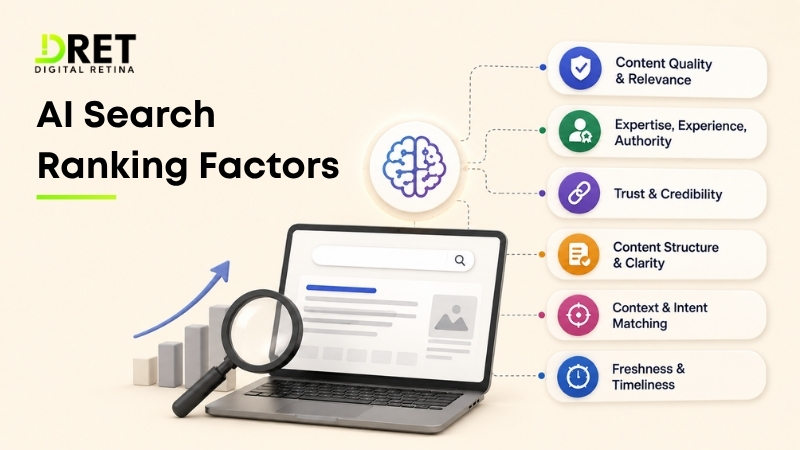
E-E-A-T stands for Experience, Expertise, Authoritativeness, and Trustworthiness. Google introduced it, but in 2026 it functions as the trust filter for both traditional search algorithms and AI citation systems.
If your content is anonymous, shallow, or unverifiable, it gets deprioritised everywhere. If it carries clear author credentials, references credible external sources, and demonstrates genuine expertise on a topic, it earns trust signals that compound over time.
For businesses in competitive sectors healthcare, finance, legal, education E-E-A-T is not optional. It is the single biggest determinant of whether your content gets cited at all. We go deeper on this in our guide to SEO services in Noida.
5. Semantic and Entity-Based Optimisation — Speaking the Language of AI
Both search engines and AI models understand content through entities specific concepts, people, places, products, and organisations and the relationships between them. They build knowledge graphs from these entities, which is how they map a website's topical expertise.
In practical terms, this means using schema markup to define your entities clearly, building comprehensive content clusters around your core topics (not just standalone pages), and earning mentions in credible knowledge sources. When an AI model consistently finds your brand associated with a specific topic across multiple credible sources, it starts treating you as an authority on that topic. That is how you get cited consistently — not through keywords, but through entity association.
The Five Pillars of a Strong HEO Strategy
foundations. Think of them as the principles that guide every decision you make.
Pillar 1: Content Authority: Your content needs to be the best available answer on a given topic. Not the longest. Not the most keyword-dense. The most genuinely useful and comprehensive. Depth beats frequency every time in AI-first search.
Pillar 2: Technical Accessibility: AI bots and search crawlers need to be able to access and understand your site easily. Clean code, fast loading, mobile optimisation, proper schema markup — these are not nice-to-haves. They are prerequisites. An AI system that cannot read your site simply cannot cite it.
Pillar 3: Multi-Surface Visibility: Each search surface — Google SERPs, voice assistants, AI chatbots, featured snippets — has different content preferences. Your strategy needs to deliberately optimise for all of them, not just Google rankings.
Pillar 4: Structured Data Integrity: Schema markup is the machine-readable layer on top of your content. It tells search engines and AI systems exactly what type of content they are looking at, who wrote it, and what questions it answers. Without it, your content is harder for machines to categorise and use.
Pillar 5: Trust Signal Consistency: Every page on your site should reinforce your brand's credibility. Author bios with real credentials. External references to legitimate data sources. A consistent publishing standard. Trust is not built on one great article — it is built on a consistent, credible body of work.
HEO vs Traditional SEO vs AEO — A Plain-English Comparison
There is a lot of confusion about how these strategies relate to each other. Here is the clearest way to think about it: they are not alternatives, they are layers. But each layer has a different job.
| Strategy | Primary Goal | Optimises For | Key Tactics | Biggest Limitation on Its Own |
| Traditional SEO | Rank in Google/Bing results | Search engine results pages (SERPs) | Keywords, backlinks, technical hygiene | Invisible to AI answer engines and voice search |
| AEO | Win featured snippets and voice answers | Featured snippets, PAA boxes, voice assistants | Q&A formatting, FAQ schema, direct answers | Does not address organic rankings or full AI citation depth |
| GEO | Get cited by generative AI tools | ChatGPT, Perplexity, Gemini, AI Overviews | Entity authority, authorship, factual accuracy, third-party presence | Does not guarantee traditional search rankings |
| HEO ✓ | Be visible everywhere people search | SERPs + AI tools + voice + snippets + chatbots | SEO + AEO + GEO + E-E-A-T + entity optimisation, unified | Requires broader planning — but covers everything else |
The key takeaway: Traditional SEO and AEO each solve part of the 2026 visibility problem. HEO solves all of it. The brands that are winning right now are not choosing between these strategies — they are combining them.
How to Implement HEO — A Step-by-Step Workflow
Let us get practical. Here is a clear, logical process for rolling out HEO — starting from zero or from an existing SEO base.
1. Start With a Multi-Surface Audit
Before you change anything, find out where you actually stand. Run a technical SEO audit with a tool like Ahrefs or Semrush. Then test your brand manually — ask ChatGPT, Perplexity, and Google a few of your core questions and see whether your content appears. Most brands are shocked by the gaps they find.
2. Map Out Your Topic Clusters
Pick the topics your brand needs to own. For each one, plan a pillar page (a comprehensive guide) supported by five to ten related articles. This cluster structure is what tells AI systems you are an authoritative source on a topic — not just one page, but a whole ecosystem of genuinely useful content.
3. Rewrite Key Pages for Direct-Answer Format
Go through your top-performing pages and restructure them. Add a clear, one-paragraph answer at the top of every major section. Add FAQ sections. Tighten your language. The goal is that every section answers one specific question, immediately, without making the reader dig. If your website shows up in AI Overviews but not getting the right traffic, our guide on fixing AI Overview visibility is a useful starting point.
4. Implement Schema Markup Across Your Site
At minimum, deploy Article schema, FAQPage schema, Organization schema, and BreadcrumbList schema. Use Google's Rich Results Test to validate your markup before it goes live. This is not optional in HEO — schema is the direct communication line between your content and every machine-based search system.
5. Strengthen Your E-E-A-T Signals
Make sure every author on your site has a visible bio with real credentials. Update your About page. Earn third-party mentions through PR, guest posts, and industry press. If you are a local or regional business, local SEO signals play a big role here too — consistent NAP data, review volume, and location authority all feed into how AI systems assess your trustworthiness.
6. Build Your Off-Site Presence
Remember: 85% of AI citations come from third-party pages. That means your HEO strategy cannot live only on your website. Publish thought leadership on LinkedIn. Participate in relevant Reddit communities. Get mentioned in industry publications. Create content that other credible sources will want to reference. Each mention trains AI models to associate your brand with your topic area.
7. Measure and Adjust — Including AI Surface Visibility
Track traditional metrics — rankings, organic traffic, click-through rates. But also track your AI surface presence. Manually test your core queries on ChatGPT, Perplexity, and Google's AI Overviews every month. Note when your brand is cited and when it is not. This is the new performance data that most businesses are still ignoring. Our post on AI SEO Services in Noida covers the tools side of this in more detail.
Tools That Actually Help With HEO
You do not need an expensive tech stack to run HEO effectively. Here are the most useful tools, organised by what they do.
For SEO Audits and Keyword Research
• Ahrefs — The gold standard for backlink analysis, keyword gap research, and content auditing. Essential for building your topic clusters with data behind them.
• Semrush — Strong keyword tracking and site audit capabilities. Its AI Overview tracking is becoming increasingly useful for measuring HEO performance.
• SE Ranking — A good value all-in-one option if you are working with a smaller budget.
For Content Optimisation and AI Readability
• Surfer SEO — Helps you optimise page content in real time, including semantic coverage and entity usage. Works well for both traditional SEO and AI readability.
• Frase — Excellent for identifying the specific questions users are asking around a topic, which is the starting point for good AEO.
• Clearscope — Grades your content on semantic depth and entity coverage. Particularly useful when you are trying to establish topical authority.
For Schema and Structured Data
• Google Rich Results Test — Free. Validates your schema before it goes live. Use it every time.
• TechnicalSEO.com Schema Generator — Fast, accurate schema markup for Article, FAQPage, Organisation, and other common types.
For Monitoring AI Surface Presence
• Manual testing on ChatGPT, Perplexity, and Gemini — Unglamorous but essential. Run your target queries monthly and record what you find.
• BrightEdge — Enterprise-level platform with emerging support for tracking AI Overview presence alongside traditional ranking data.
• VisibAI — A newer platform specifically built to audit how your brand appears across six major AI platforms. Useful for agencies managing multiple clients.
For Performance and Analytics
• Google Search Console — Still the most reliable source of organic search performance data. Track impressions, CTR, and indexing health.
Google Analytics 4 — Monitors user behaviour and conversion paths from different traffic sources.
Best Practices for Hybrid Engine Optimization — What Actually Works
These are not generic tips. They come from what the data and the leading practitioners are showing works in 2026.
Answer the question in the first sentence. Every section of your content should open with the direct answer to whatever question that section is addressing. Do not build up to the answer. Give it immediately. This is exactly how AI Overviews and featured snippets extract content — they take the first clear answer they find.
Write for humans first, structure for machines second. This is Jori Ford's own advice, and it is the most important principle in HEO. If your content reads like it was written for a bot, both humans and AI tools will skip it. Conversational, clear, expert writing that happens to be well-structured will outperform keyword-heavy content on every modern search surface.
Use FAQ sections on every informational page. FAQs are one of the most powerful tools in HEO. They target voice search, they match conversational queries, they earn PAA box appearances, and when marked up with FAQPage schema they become prime candidates for AI citation. Do not treat them as an afterthought.
Put real author credentials on every piece. Faceless content is increasingly invisible. Every article on your site should have an author name, a brief bio, and a link to a full author page with verifiable credentials. This is an E-E-A-T requirement and an AI citation requirement.
Cite your data sources. AI systems evaluate whether your content is part of the credible information ecosystem — or outside it. When you reference statistics or research, link to the original source. When you make claims, back them up. Content that cites credible external sources gets cited far more often than content that does not.
Keep your content fresh. Stale content erodes trust with both users and algorithms. Set a content review schedule and update your key posts at least once a year — or immediately when the facts change. In fast-moving sectors like digital marketing, quarterly reviews are more appropriate.
Build topic clusters, not standalone pages. A single excellent article is not enough to establish topical authority. You need a pillar page supported by multiple related articles that all link to each other intelligently. This is what convinces both Google and AI systems that your website is a genuine authority on a subject — not just a page that covers it once.
Earn presence outside your own site. Reddit, LinkedIn, industry blogs, podcasts, press mentions — these are not just nice-to-haves. They are the training data that AI models use to decide which brands to associate with which topics. Build a genuine presence across the platforms that AI systems frequently draw from.
Common HEO Mistakes to Avoid
These are the errors that waste effort and slow results. Knowing them upfront will save you a lot of time.
Treating HEO as just extra SEO steps. This is the most common mistake. HEO requires a different mindset, not just additional tasks. The goal shifts from 'ranking' to 'presence everywhere.' If you approach it as an SEO checklist extension, you will miss the bigger strategic shift.
Skipping schema markup. There is no shortcut around this. Schema is how machines read and categorise your content. Without it, you are making your content harder to understand for both Google's crawlers and AI citation systems. It takes time to implement but the compound returns are significant.
Writing without a named author. Anonymous content is low-trust content. If your articles do not have a real, credible human behind them, AI systems and Google's quality evaluators both treat them with scepticism. This is fixable and it makes a measurable difference.
Measuring success only through Google rankings. If you are not tracking AI surface presence — whether your brand shows up when users ask relevant questions in ChatGPT or Perplexity — you are working with incomplete data. You might be winning on one surface while losing badly on another.
Doing HEO only on your website. Given that most AI citations come from third-party sources, an HEO strategy that lives entirely on your own domain is missing most of the opportunity. Off-site presence building is not optional — it is half the job.
Expecting overnight results. HEO is a long-term investment, especially on the AI surface side. AI models learn associations over time through repeated, consistent exposure. The brands that start now will have a meaningful advantage over those that wait six months. But you will not see the full payoff in week two.
Frequently Asked Questions About HEO
Is traditional SEO still worth doing in 2026?
Absolutely. Technical SEO, backlinks, and on-page optimization are the foundation of HEO. AI bots use the same indexing infrastructure as Google's crawlers. If your SEO foundations are weak, nothing else works.
Does HEO replace SEO?
No. HEO includes SEO and builds on top of it. You do not abandon your existing SEO strategy — you expand it to cover the surfaces that traditional SEO does not address.
How is GEO different from AEO?
AEO focuses on featured snippets, PAA boxes, and voice search results — structured answers within the search engine interface. GEO focuses on getting your content cited within the synthesised responses generated by AI tools like ChatGPT and Perplexity. HEO covers both.
How long does it take to see HEO results?
Traditional SEO improvements from HEO can be visible within weeks. AI citation improvements typically take longer — two to six months for meaningful, consistent presence — because AI models need time to process and associate your content with your topics.
Do small businesses need HEO?
Yes, but with focus. Small businesses cannot do everything at once, so prioritise the basics: strong E-E-A-T signals, FAQ schema on key pages, and content that directly answers the questions your customers actually ask. Those three moves alone will put you ahead of most competitors.
Conclusion
Search in 2026 is not just about ranking on Google anymore. People now find brands through AI Overviews, ChatGPT, Perplexity, voice search, and featured snippets. If you focus only on traditional SEO, you’re missing a big part of modern search visibility.
That’s where Hybrid Engine Optimization (HEO) comes in. It helps your brand appear across both search engines and AI platforms using one connected strategy — without rebuilding everything from scratch.
The best time to start is now. Small improvements like better schema, stronger author profiles, and clear answer-focused content can make a big difference in how AI platforms understand and recommend your brand.
At Digital Retina(DRET), we help businesses across India prepare for this shift with AI-ready SEO audits, content strategy, and technical optimisation. Reach out for a free consultation and see where your brand stands today.
Ready to Implement These Strategies?
Our team of digital marketing experts can help you navigate these trends and create a winning strategy.