

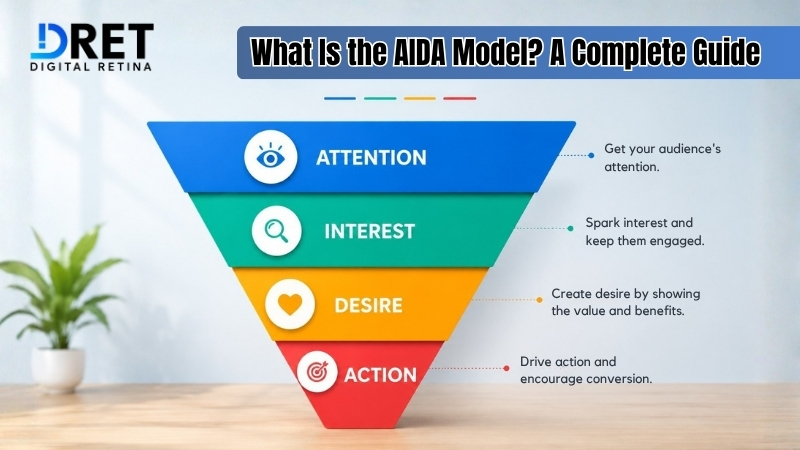
Every successful marketing campaign has one goal: move people from discovering a brand to taking action. The AIDA Model provides a simple framework for doing exactly that. By understanding the four stages—Attention, Interest, Desire, and Action—businesses can create marketing messages that attract the right audience, build trust, and improve conversions.
Whether you're writing website copy, planning a marketing campaign, creating social media ads, optimizing a landing page, or improving your content marketing strategy, the framework helps you deliver the right message at the right stage of the customer journey.
In this guide, you'll learn what the AIDA Model is, how it works, why it remains relevant in modern marketing, and how to apply it with practical examples to create content that converts.
What Is the AIDA Model?
The AIDA Model is one of the most widely used marketing frameworks for understanding how customers move from discovering a product or service to taking action. It describes four psychological stages that influence purchasing decisions:
-
Attention – Capture the audience's attention.
-
Interest – Build curiosity and engagement.
-
Desire – Show why your solution is valuable.
-
Action – Encourage the customer to take the next step.
Rather than pushing for an immediate sale, the model focuses on building awareness, trust, and confidence over time. Each stage prepares customers for the next, making marketing messages more persuasive and relevant.
Today, businesses apply this framework across SEO, content marketing, email campaigns, paid advertising, social media, landing pages, and sales presentations because it provides a practical way to communicate with potential customers throughout the buying journey.
The History of the AIDA Model
The framework traces its origins to advertising pioneer E. St. Elmo Lewis, who introduced it in 1898 to explain how salespeople could guide prospects from first noticing a product to completing a purchase.
Although marketing channels have evolved dramatically since then, the psychology behind customer decision-making has remained remarkably consistent. Today, marketers continue using the AIDA Model because it provides a practical structure for creating persuasive messages across both digital and traditional marketing channels.
Over time, the framework has become a foundation for modern copywriting, advertising, and conversion optimization. While customer journeys are now influenced by search engines, social media, AI-powered search experiences, and online reviews, the core principle remains unchanged: people need the right information at the right time before they're ready to act.
Why Is the AIDA Model Still Relevant Today?
The way people discover brands has changed significantly over the past decade. Customers now research products through Google Search, AI assistants, YouTube videos, social media, online reviews, comparison websites, and recommendations before making a purchase.
Despite these changes, one thing hasn't changed: customers rarely buy something the first time they encounter it. They first need to recognize a problem, understand possible solutions, evaluate their options, and build confidence before making a decision.
That's why the AIDA Model continues to be valuable. Instead of focusing only on selling, it helps marketers understand what information customers need at different stages of the consumer decision-making process.
For example:
-
A search-optimized blog post or advertisement captures Attention.
-
Educational content builds interest by answering important questions.
-
Testimonials, reviews, and case studies create Desire by demonstrating real value.
-
A clear call-to-action encourages visitors to take the next step.
One important point to remember is that today's customer journey is rarely linear. Someone may discover your brand through a social media post, compare competitors on Google, ask an AI assistant for recommendations, read customer reviews, and return days or even weeks later before making a purchase.
For this reason, experienced marketers use the AIDA Model as a communication guide rather than a rigid formula. Its greatest strength lies in helping businesses deliver the right message at the right moment, regardless of where customers enter the buying journey.
What Does AIDA Stand For?
The AIDA Model is built around four stages that represent how customer interest typically develops before a conversion.
Attention
Capture your audience's attention with a relevant and compelling message.
Interest
Keep them engaged by helping them understand their problem and showing why it matters.
Desire
Demonstrate how your product or service solves that problem and creates meaningful value.
Action
Encourage customers to take a clear next step, such as making a purchase, requesting a demo, subscribing to a newsletter, or contacting your business.
Together, these four stages provide a practical framework for creating marketing messages that align with both the marketing funnel and the customer journey.
Note: Some marketers use Awareness instead of Attention as the first stage of the AIDA Model. While the wording differs, the objective is the same: introducing your brand and capturing the attention of potential customers before encouraging deeper engagement.
Understanding the Four Stages of the AIDA Model
The strength of the AIDA Model lies in its simplicity. Instead of encouraging businesses to sell immediately, it helps them understand what customers need at each stage of the buying journey. By delivering the right message at the right time, marketers can build trust, strengthen engagement, and improve conversions.
Let's look at each stage in detail.
1. Attention – Capture the Right Audience
The first stage is Attention.
Before someone can consider your product or service, they need to notice it. In today's digital landscape, consumers are exposed to thousands of marketing messages every day, making attention one of the most valuable—and hardest to earn—resources.
The goal isn't to attract everyone; it's to attract the people most likely to become customers.
How to Capture Attention
Effective ways to capture attention include:
-
Writing benefit-driven headlines
-
Addressing a specific customer pain point
-
Asking a thought-provoking question
-
Using compelling visuals or videos
-
Highlighting a surprising statistic or insight
-
Clearly communicating your unique value proposition
Example
Instead of writing:
Project Management Software
Write:
Still Managing Projects with Spreadsheets? Here's a Smarter Way.
The second headline immediately addresses a common frustration and encourages readers to learn more.
Best Practice: Great headlines don't just generate clicks—they set accurate expectations. When your headline matches the content that follows, visitors are more likely to stay engaged and trust your brand.
2. Interest – Turn Attention into Engagement
Capturing attention is only the first step. The next challenge is giving people a reason to keep reading, watching, or exploring.
The Interest stage focuses on educating potential customers rather than selling to them. Instead of talking about your product immediately, help your audience better understand their problem and the available solutions.
This is where informative, helpful content becomes one of your strongest marketing assets.
Ways to Build Interest
-
Educational blog posts
-
Product demonstrations
-
Webinars and videos
-
Case studies
-
Industry reports
-
Free templates, guides, or checklists
-
Interactive tools and calculators
For example, a software company might publish an article explaining why manual workflows reduce team productivity before introducing its automation platform. By solving part of the reader's problem first, the business builds credibility and trust.
Best Practice: Ask yourself, "Would someone still find this content useful even if they didn't buy from us?" If the answer is yes, you're likely creating genuine interest instead of simply promoting a product.
3. Desire – Show Why Your Solution Matters
Interest alone doesn't lead to conversions. Customers also need to believe that your solution is the right choice for them.
The Desire stage transforms curiosity into motivation by helping people visualize the value your product or service provides.
One of the most effective ways to do this is by focusing on outcomes instead of features.
Feature vs. Benefit
Feature
AI-powered email automation.
Benefit
Automatically send personalized emails to the right audience and save hours of manual work every week.
Customers rarely buy a feature because it's technically impressive—they buy it because it saves time, solves a problem, reduces effort, or helps them achieve a better result.
Ways to Build Desire
-
Customer testimonials
-
Success stories
-
Product demonstrations
-
Before-and-after examples
-
Independent reviews
-
Expert endorsements
-
Social proof
-
Clear value propositions
These trust signals reduce uncertainty and help potential customers feel more confident about choosing your business.
Best Practice: Whenever possible, support your claims with evidence. Real customer experiences, measurable results, and authentic reviews are often more persuasive than marketing promises.
4. Action – Encourage the Next Step
The final stage is Action.
At this point, customers understand the problem, recognize the value of your solution, and are ready to decide. Your job is to make the next step clear and easy.
Depending on your goals, that action could include:
-
Purchasing a product
-
Starting a free trial
-
Booking a consultation
-
Downloading an eBook
-
Requesting a quote
-
Scheduling a product demo
-
Subscribing to a newsletter
A strong call-to-action should remove uncertainty by telling visitors exactly what they should do next.
Examples of Effective CTAs
-
Start Your Free Trial
-
Book a Demo
-
Get Your Free Quote
-
Download the Guide
-
Schedule a Consultation
Best Practice: Avoid placing multiple competing CTAs on the same page. A single, focused action usually performs better because it gives visitors one clear path to follow.
IDA Model Example
Imagine a company launching a new online fitness app.
Attention
A Google Ad appears with the headline:
"Why Most Workout Plans Fail Within 30 Days."
Instead of immediately promoting the app, the headline highlights a common frustration that encourages the right audience to click.
Interest
The landing page explains why consistency is one of the biggest challenges in achieving fitness goals. It includes expert tips, short videos, and practical advice before introducing the app as a solution.
Desire
Visitors see customer success stories, transformation photos, ratings, and testimonials that demonstrate how the app has helped real users build healthier habits.
Action
The page concludes with one clear CTA:
Start Your 14-Day Free Trial
Each stage naturally supports the next, making the decision to sign up feel informed rather than pressured.
Real-World Example: How Apple Applies the AIDA Model
Apple's product launches are frequently cited as an example of how the AIDA Model can be applied in modern marketing. While every campaign is unique, Apple's approach closely reflects the four stages of the framework.
Attention
Keynote events, teaser announcements, and widespread media coverage generate curiosity long before a product becomes available.
Interest
Launch presentations explain new features, demonstrate real-world use cases, and show how the product improves everyday experiences.
Desire
Professional product visuals, hands-on demonstrations, customer stories, and the broader Apple ecosystem help consumers imagine owning and using the product.
Action
Once products become available, Apple's website and retail stores make it easy for customers to compare models, place an order, or explore available purchasing options.
Although no marketing campaign follows the framework perfectly, Apple's launches demonstrate how compelling storytelling, product experience, and clear communication can move customers from awareness to action.
How the Four Stages Work Together
While the four stages are often explained individually, they're most effective when used together as one connected process.
Think of the AIDA Model as a conversation with your audience:
-
Attention introduces your brand.
-
Interest builds understanding and engagement.
-
Desire develops trust and preference.
-
Action encourages a meaningful next step.
Skipping one of these stages can weaken the customer experience. For example, asking visitors to buy immediately without first building trust or demonstrating value often leads to lower conversion rates.
The most successful marketing campaigns guide customers naturally through each stage, making the buying decision feel easier and more confident.
AIDA Model vs. Marketing Funnel
Although the AIDA Model and the marketing funnel are closely related, they serve different purposes.
The marketing funnel maps the overall journey from discovering a brand to becoming a customer. The AIDA Model focuses on the communication strategy that helps move people through each stage of that journey.
|
AIDA Stage |
Marketing Funnel Stage |
Primary Goal |
|
Attention |
Awareness |
Capture attention and introduce the brand |
|
Interest |
Consideration |
Educate and build engagement |
|
Desire |
Evaluation |
Strengthen trust and preference |
|
Action |
Conversion |
Encourage the desired action |
Used together, these frameworks help businesses create more effective marketing campaigns, improve customer engagement, and develop content that supports the entire buying journey.
Benefits of the AIDA Model
More than a century after its introduction, the AIDA Model remains one of the most widely used marketing frameworks because it is simple, adaptable, and centered on customer behavior. Instead of focusing only on selling, it helps marketers understand what customers need to see, know, and believe before making a decision.
Here are some of its key benefits:
Provides a Clear Marketing Structure
The framework gives marketers a logical process for planning campaigns, writing copy, and creating content. Every message has a purpose—from attracting attention to encouraging action.
Improves Customer Engagement
Each stage answers a different customer question. This makes your content feel more relevant and helpful, keeping potential customers engaged instead of overwhelming them with sales messages.
Creates More Persuasive Marketing
Rather than highlighting product features alone, the model encourages businesses to communicate benefits, outcomes, and real customer value. This approach naturally supports persuasive marketing and improves conversion-focused content.
Works Across Multiple Channels
The AIDA Model can be applied to almost every marketing channel, including:
-
SEO and content marketing
-
Email marketing
-
Social media campaigns
-
Paid advertising
-
Landing pages
-
Product pages
-
Sales presentations
Its flexibility makes it a valuable framework for businesses of all sizes and industries.
Limitations of the AIDA Model
Despite its popularity, the AIDA Model isn't a perfect representation of how every customer makes purchasing decisions. Understanding its limitations helps marketers use it more effectively.
1. Customer Journeys Don't Always Follow Four Fixed Steps
One of the main criticisms of the AIDA Model is that it assumes customers move through the four stages in a predictable sequence. In practice, people may skip stages, revisit earlier ones, or compare multiple brands before making a decision.
This doesn't make the framework ineffective—it simply means marketers should use it as a planning guide rather than expect every customer journey to follow the same path.
2. It Focuses Mainly on Customer Acquisition
The original framework ends with Action, but modern marketing doesn't stop after a purchase.
Customer satisfaction, loyalty, referrals, and repeat purchases are essential for long-term growth. Businesses that invest in retention often achieve greater lifetime customer value than those focused only on acquiring new customers.
3. It Doesn't Capture Every Buying Decision
Purchasing decisions are influenced by many factors, including emotions, brand reputation, pricing, convenience, peer recommendations, and timing.
While the AIDA Model provides a helpful structure, it cannot explain every customer decision or buying behavior.
4. Limited Empirical Evidence
Although the framework has influenced marketing for more than 125 years, researchers have found limited empirical evidence proving that every customer consistently follows these four stages. For this reason, many marketers use it as a practical planning framework rather than a strict rule.
Key takeaway: The AIDA Model works best when combined with customer research, analytics, and continuous testing.
Modern Variations of the AIDA Model
As marketing evolved, several variations of the framework were introduced to reflect changing customer expectations and long-term relationship building.
AIDAS
This version adds Satisfaction after Action.
The idea is simple: a successful marketing campaign shouldn't end with a purchase. A positive customer experience encourages repeat purchases, recommendations, and long-term loyalty.
AIDAR
This variation adds Retention (or Relationship) after Action.
Instead of viewing conversion as the finish line, it emphasizes nurturing customers through ongoing communication, excellent service, and loyalty-building initiatives.
Where Does AIDA Fit in Marketing Theory?
The AIDA Model belongs to a broader family of frameworks known as Hierarchy of Effects models. These models explain how customers progress through a series of psychological stages before making a purchase.
While different frameworks describe this journey in different ways, they all share the same objective: helping marketers understand how communication influences customer decision-making over time.
Best Practices for Applying the AIDA Model
Understanding the framework is only the first step. Success depends on how effectively you apply it.
Here are some practical best practices:
-
Know your audience before creating content.
-
Lead with customer problems, not product features.
-
Use testimonials, reviews, or case studies to build credibility.
-
Focus on benefits instead of technical specifications.
-
Keep your call-to-action simple and specific.
-
Test headlines, landing pages, and CTAs regularly to improve results.
-
Measure performance using analytics and refine your messaging over time.
Practical Insight
In many SEO and conversion optimization projects, pages with the highest traffic don't always generate the most leads. One of the biggest improvements often comes from strengthening the Interest and Desire stages—answering customer questions more clearly, adding proof points, and making the value proposition easier to understand before asking visitors to convert.
Frequently Asked Questions
Is the AIDA Model still relevant today?
Yes. Although modern buying journeys are more complex than when the model was introduced, its core principles remain highly relevant across SEO, content marketing, email marketing, social media, paid advertising, and landing page optimization.
What's the difference between the AIDA Model and the marketing funnel?
The marketing funnel describes the overall customer journey, while the AIDA Model explains the communication strategy used to move customers through that journey. The two frameworks complement each other and are often used together.
What are the 4 principles of advertising in the AIDA Model?
The four principles of the AIDA Model are Attention, Interest, Desire, and Action. These stages help businesses attract potential customers, build interest, create desire, and encourage them to take a specific action, such as making a purchase or signing up.
What is the difference between the 4 Ps and the AIDA Model?
The 4 Ps focus on creating a marketing strategy through Product, Price, Place, and Promotion, while the AIDA Model focuses on communicating that strategy effectively. The two frameworks work together to attract, engage, and convert customers.
What are the four stages of the AIDA Model?
The four stages of the AIDA Model are Attention, Interest, Desire, and Action. Together, they explain how customers typically move from discovering a brand to taking a desired action, making the framework useful for advertising, content marketing, and sales.
Final Thoughts
The AIDA Model has remained relevant for more than 125 years because it reflects a fundamental truth about marketing: people need the right information at the right time before they're ready to make a decision.
Although today's customer journey is shaped by search engines, AI-powered search experiences, social media, online reviews, and multiple digital touchpoints, the principles of Attention, Interest, Desire, and Action continue to provide a practical foundation for effective marketing communication.
Rather than treating the framework as a rigid sequence, use it as a guide for creating customer-focused experiences. Combine it with audience research, testing, analytics, and valuable content, and you'll build marketing campaigns that do more than attract clicks—they'll earn trust, strengthen relationships, and drive meaningful business results.
Whether you're writing a blog post, designing a landing page, creating email campaigns, or planning a broader digital marketing strategy, the AIDA Model remains one of the simplest and most effective frameworks for creating content that converts.
Ready to Implement These Strategies?
Our team of digital marketing experts can help you navigate these trends and create a winning strategy.