

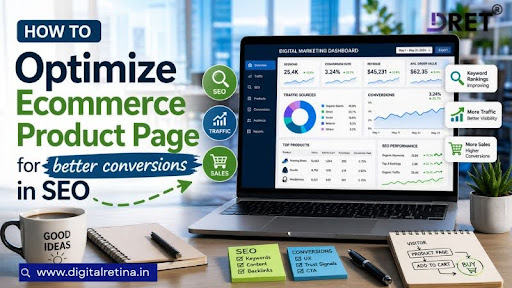
An Ecommerce Product Page plays a critical role in turning visitors into customers. No matter how much traffic your website gets, conversions only happen when your pages are properly optimized. A well-structured layout not only improves search engine rankings but also enhances user experience, builds trust, and increases revenue.
Product page SEO focuses on making individual listings visible in search results while ensuring they provide useful information to buyers. When done correctly, it supports both SEO performance and conversion rate optimization, helping businesses grow sustainably.
What is an Ecommerce Product Page?
An Ecommerce Product Page is a dedicated webpage that provides detailed information about a specific item. It helps users understand features, benefits, pricing, and availability before making a purchase decision.
Key Elements of a Standard Page
- Title
- Images or videos
- Description and features
- Price and availability
- Add-to-cart button
- Customer reviews
- Shipping and return details
Role in the Buyer Journey
These pages sit at the bottom of the sales funnel. Users landing here usually have strong buying intent, which means proper product page SEO can directly impact conversions.
Category Page vs Product Page
- Category page lists multiple items
- Detail page focuses on one item in depth
- Category page targets broader keywords
- Detail page targets specific long-tail keywords
Why Optimizing Product Pages is Tricky
Optimizing an Ecommerce Product Page is not as simple as adding keywords. These pages must rank in search results, provide useful information, and encourage users to buy — all at the same time. Balancing SEO, user experience, and conversions makes optimization challenging.
One major issue is duplicate content. Many eCommerce sites use manufacturer descriptions, which results in similar content across different websites. This makes it difficult for search engines to decide which page should rank.
Another challenge is thin descriptions. Pages with limited information fail to answer user queries and often lead to higher bounce rates. Search engines also prefer detailed, helpful content.
Technical SEO adds more complexity. Filters, pagination, and URL parameters can create multiple versions of the same listing, which may dilute ranking signals if not handled properly.
Managing variants like size or color is also tricky, as it can create duplicate URLs if not structured correctly. Additionally, a mismatch between user intent and content can reduce conversions when pages lack reviews, comparisons, or detailed benefits.
Because of these factors, businesses need a balanced e-commerce SEO strategy that focuses on both search visibility and user experience.
SEO Checklist of Ecommerce Product Page (Advanced Ecommerce SEO Strategist Perspective)
From an advanced Ecommerce Product Page optimization standpoint, the checklist goes beyond basic keyword placement. It focuses on search intent, crawl efficiency, structured data, and conversion-driven UX. A strategic approach ensures that each listing performs well in both rankings and sales.
On-Page SEO (Strategic Content Optimization)
Advanced product page SEO starts with intent-driven content rather than just keyword usage. Each element should help search engines understand relevance while guiding users toward conversion.
- Optimize titles for intent – Include brand, model, and key feature naturally to match commercial queries.
- Create unique, conversion-focused descriptions – Highlight benefits, use cases, and differentiators.
- Use structured heading hierarchy – H1 for name, H2 for features, FAQs, and specifications.
- Implement keyword clustering – Target primary and related terms within sections like features and FAQs.
- SEO-friendly URL structure – Keep URLs short, descriptive, and aligned with category hierarchy.
Technical SEO (Crawlability & Indexation)
Technical optimization ensures search engines efficiently crawl and index pages, especially for large eCommerce websites.
- Improve Core Web Vitals – Optimize LCP, CLS, and INP.
- Mobile-first optimization – Ensure responsive design and fast loading.
- Implement schema markup – Add price, availability, ratings, and brand.
- Use canonical tags – Prevent duplicate content from filters and variants.
- Optimize faceted navigation – Control indexation of filtered URLs.
- XML sitemap optimization – Include only indexable pages.
User Experience (Conversion-Focused Optimization)
User experience is directly tied to conversion rate and engagement metrics, which indirectly influence SEO performance.
- Clear and prominent CTA buttons – Place above the fold.
- High-quality images with zoom – Improve user confidence.
- Trust signals and guarantees – Add secure payment icons and return policy.
- Simplified navigation and layout – Reduce friction.
- Above-the-fold optimization – Display price, rating, and CTA without scrolling.
- Include social proof – Reviews and ratings increase trust.
By combining advanced on-page SEO, technical optimization, and conversion-focused UX, an Ecommerce Product Page can achieve stronger rankings while maximizing sales performance.
Applying the Pareto Principle and Growth Mindset
Not every page requires the same level of effort. The Pareto Principle suggests that a small percentage of listings often generate most of the revenue. Instead of optimizing hundreds of pages at once, start with your top-performing ones.
Identify which pages bring the most traffic or sales, and improve them first. Small changes like better descriptions, stronger CTAs, or improved images can significantly impact conversions.
You should:
- Focus on top-performing pages
- Improve high-impact conversion elements
- Test different layouts and CTA placements
- Track performance regularly
This growth mindset allows businesses to achieve better results with focused optimization.
How DRET – Digital Retina Helps Optimize Ecommerce Product Pages
Optimizing an Ecommerce Product Page requires a mix of technical SEO, content strategy, and conversion-focused design. At DRET – Digital Retina, we help eCommerce businesses improve visibility and drive more sales through data-driven optimization.
Our approach focuses on:
1. Optimize Titles
Titles should clearly describe the item while including the primary keyword naturally. A strong title typically includes brand name, type, and key feature.
2. Write Unique Descriptions
Avoid copying content from manufacturers or competitors. Instead, create unique descriptions that highlight benefits, features, and use cases.
3. Improve Ecommerce Product Page Design
A clean ecommerce product page design improves user engagement. Make sure the layout is simple, the add-to-cart button is visible, and the page works smoothly on mobile devices.
4. Optimize Images and Media
Images play a major role in conversions. Use descriptive alt text, compress images for speed, and add videos when possible.
5. Add Customer Reviews
Reviews build trust and add fresh content. Positive feedback influences buying decisions and improves SEO performance.
6. Optimize URL Structure
URLs should be short, readable, and keyword-focused.
Example:
Good: /wireless-bluetooth-headphones
Bad: /product?id=12345
7. Use Internal Linking
Link related items, categories, and recommended sections to improve navigation and engagement.
8. Add Schema Markup
Structured data helps search engines understand details. Use:
- Schema
- Review schema
- Price and availability
This can also improve click-through rates in search results.
By combining SEO expertise with conversion strategy, DRET – Digital Retina helps businesses turn their product pages into high-performing revenue assets. Whether you're launching a new store or improving existing pages, a structured optimization strategy can significantly improve both rankings and conversions.
Common Mistakes to Avoid
- Using duplicate descriptions
- Missing meta titles and descriptions
- Slow loading pages
- Poor mobile experience
- Not adding customer reviews
Avoiding these issues ensures better SEO performance and higher conversions.
Best Ecommerce Product Page SEO Strategy
An effective strategy combines SEO with conversion optimization. Start by performing keyword research for each listing and understanding user intent. Then create content that answers customer questions and highlights value.
You should:
- Perform keyword research for every item
- Create intent-focused descriptions
- Combine CRO with SEO improvements
- Test and optimize continuously
This balanced approach helps improve both rankings and sales.
Conclusion
Optimizing an Ecommerce Product Page is essential for improving visibility and conversions. By focusing on content quality, technical SEO, user experience, and design, businesses can create pages that attract and convert customers.
Start with your most important listings, apply a structured strategy, and continuously test improvements. When SEO and user experience work together, these pages become powerful tools for long-term growth.
Ready to Implement These Strategies?
Our team of digital marketing experts can help you navigate these trends and create a winning strategy.