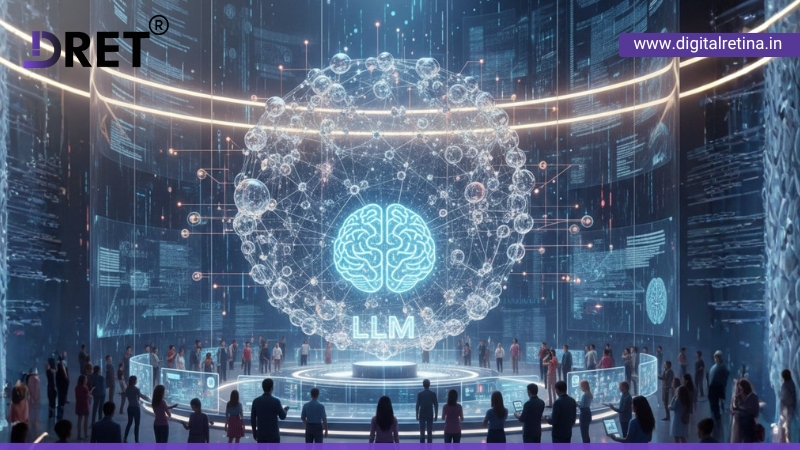
A Large Language Model (LLM) is an advanced artificial intelligence system designed to understand, generate, and analyze human language at scale. Built using deep learning techniques—especially transformer architectures—LLMs are trained on massive volumes of text data, including websites, books, articles, and code. This training enables them to recognize language patterns, context, semantics, and intent, allowing them to perform tasks such as content creation, translation, summarization, coding assistance, chatbots, customer support, and even providing insights for website speed optimization with high accuracy.
LLMs work by predicting the next word (or token) in a sequence based on context, using billions of parameters that adjust during training to improve language understanding. When a user inputs a prompt, the model processes it through multiple neural network layers, evaluates contextual relationships, and generates a coherent, relevant response in real time. Modern LLMs also leverage fine-tuning, reinforcement learning, and prompt engineering to improve reliability, relevance, and safety—making them a core technology behind today’s AI-powered applications, including AI Content Marketing, business automation, and other technology solutions.
What Is LLM (Large Language Model)?
An LLM (Large Language Model) is a type of artificial intelligence model designed to understand, generate, and respond to human language in a natural and meaningful way. It belongs to the field of Natural Language Processing (NLP) and is built using advanced deep learning techniques. Unlike traditional rule-based software, LLMs learn language patterns directly from data. They do not store predefined answers—instead, they predict language dynamically based on context. LLMs can perform tasks such as:
- Conversational AI (chatbots and assistants)
- Content writing and editing
- Language translation
- Text summarization
- Code generation and debugging
- Knowledge-based question answering
Evolution of Language Models (From Simple to LLMs)
Understanding Large Language Models (LLMs) becomes easier when we look at how language models have evolved over time. Each stage improved how machines understand and generate human language.
Rule-Based Systems - Early models depended on predefined rules and keywords. They worked only for simple commands and failed with complex or natural language variations.
Statistical Language Models - These models used word frequency and probability to predict text. While more flexible, they struggled to understand context and long sentences.
Neural Network Models - Neural networks improved accuracy by learning language patterns from data, but handling long-form context remained a challenge.
Transformer-Based LLMs - Modern LLMs use transformer architecture with self-attention, enabling deep understanding of context, intent, and long-form content with high precision.
This evolution is what makes today’s LLMs more intelligent, scalable, and practical for real-world applications.
Why Are LLMs Called “Large”?
LLMs are called large because of the scale at which they are built and trained.
Massive Training Data
They are trained on vast datasets that include articles, blogs, research papers, documentation, forums, and public web content, allowing them to understand diverse language patterns.
Billions of Parameters
Parameters are internal numerical values the model learns during training. A higher number of parameters enables better context understanding, improved reasoning, and higher response accuracy.
High Computational Infrastructure
Training and running LLMs requires powerful cloud infrastructure, GPUs, and advanced AI frameworks to process data efficiently.
Core Technology Behind LLMs – Transformer Architecture
The foundation of modern LLMs is the Transformer architecture, a breakthrough that allows AI models to process language efficiently while maintaining deep contextual understanding.
Tokenization - Text is divided into smaller units called tokens (words or word fragments). This step helps the model handle large volumes of text and understand language structure more effectively.
Word Embeddings - Each token is transformed into a numerical vector known as an embedding. These embeddings represent semantic meaning, allowing the model to recognize relationships, similarities, and differences between words.
Self-Attention Mechanism - Self-attention enables the model to evaluate the importance of each word in relation to others within a sentence or paragraph. This allows it to understand long-range dependencies, capture context accurately, and generate relevant responses.
Multi-Layer Neural Networks - Transformers use multiple neural network layers, where each layer refines understanding and improves language representation. This layered learning results in more coherent, accurate, and human-like outputs.
How LLMs Learn Language (Training Process)?
Large Language Models learn language through a multi-stage training process that helps them understand patterns, context, and intent in human communication.
1. Pre-Training
During pre-training, the model is exposed to massive datasets and learns general language patterns by predicting missing or next words in sentences. This stage builds a strong foundation in grammar, vocabulary, and contextual understanding.
2. Fine-Tuning
After pre-training, the model is trained on more specific and curated datasets to improve performance. Fine-tuning helps enhance accuracy, align tone, and make the model more relevant to particular domains or use cases.
3. Reinforcement Learning with Human Feedback (RLHF)
In this final stage, human reviewers evaluate and guide model responses. Their feedback helps the model produce safer, more accurate, and more useful outputs that align with real-world expectations.
How an LLM Generates an Answer?
When a user enters a prompt, an LLM follows a structured process to generate a response:
First, the input text is tokenized, breaking it into smaller units so the model can process it efficiently. Next, the model analyzes the context using attention layers, identifying relationships and meaning across the entire input.
Based on this understanding, the LLM calculates probabilities for the next most likely token and begins generating the response one token at a time. Each generated token influences the next, ensuring coherence and relevance.
This entire process happens in real time, allowing LLMs to produce fluent, context-aware, and human-like outputs within seconds.
Types of Large Language Models
Large Language Models can be categorized based on their training focus and capabilities.
General-Purpose LLMs - These models are designed to handle a wide range of tasks such as content creation, conversation, coding, and summarization. GPT-based models are common examples used across multiple industries.
Domain-Specific LLMs - Domain-specific LLMs are trained on specialized datasets tailored to particular industries like healthcare, finance, legal, or e-commerce. This makes them more accurate and reliable for industry-specific use cases.
Multimodal LLMs - Multimodal LLMs can understand and generate multiple types of data, including text, images, audio, and video. This enables richer interactions, such as image-based queries, voice assistants, and advanced AI applications.
Real-World Applications of LLMs
Large Language Models are widely used across industries to automate tasks, improve efficiency, and enhance decision-making.
Digital Marketing & AI Content Marketing
LLMs help marketers create SEO-friendly blogs, optimize ad copy, personalize email campaigns, and automate social media content, enabling faster execution and consistent messaging at scale.
Customer Support
AI-powered chatbots use LLMs to provide instant responses, handle customer queries 24/7, and classify support tickets, reducing response times and operational costs.
Business Operations
LLMs streamline internal processes by automating lead qualification, integrating with CRM systems, and managing internal knowledge bases for quick information access.
Software Development
In development workflows, LLMs assist with code generation, technical documentation, and bug detection, helping teams improve productivity and code quality.
Benefits of LLMs for Businesses
Large Language Models offer numerous advantages for modern businesses:
- Faster Decision-Making: LLMs analyze data and generate insights quickly, helping businesses make informed decisions in real time.
- Reduced Operational Costs: Automating repetitive tasks like content creation, customer support, and data processing lowers operational expenses.
- Scalable Automation: Businesses can scale operations without proportionally increasing human resources, thanks to AI-driven workflows.
- Improved Customer Experience: LLMs enable personalized and responsive communication, enhancing customer satisfaction.
- Personalized Marketing at Scale: From tailored email campaigns to dynamic content generation, LLMs help marketers deliver targeted experiences for every audience segment.
At DRET, we specialize in helping businesses integrate LLM-powered AI solutions into their digital marketing and growth strategies, unlocking efficiency, scalability, and innovation.
Future of LLMs in AI and Digital Marketing
The future of Large Language Models promises transformative changes in how businesses operate and engage with customers:
- Hyper-Personalized Marketing Campaigns: LLMs will enable brands to deliver highly targeted content, offers, and recommendations tailored to individual user behavior.
- Voice-Enabled AI Assistants: Conversational AI will become more natural and context-aware, allowing seamless voice interactions across platforms.
- Autonomous AI Agents: LLMs will power AI agents capable of performing complex tasks independently, such as managing campaigns or analyzing data in real time.
- Deeper Integration with Ads, Analytics, and CRM Systems: Businesses will leverage LLMs for smarter decision-making, enhanced customer insights, and optimized marketing automation.
Organizations that adopt LLM technology early will gain a significant competitive advantage, improving efficiency, personalization, and overall business growth.
Conclusion
Large Language Models are transforming how businesses interact with technology. From automation to AI-driven marketing, LLMs are becoming the foundation of intelligent digital ecosystems. If your business wants to adopt LLM-powered AI, automation, or AI content marketing, DRET provides end-to-end strategy, implementation, and optimization.
Ready to Implement These Strategies?
Our team of digital marketing experts can help you navigate these trends and create a winning strategy.